Chasing the northern lights by car from Tromsø
Tromsø lies inside the auroral zone, but the lights of the city wash much of the sky out. On a clear winter night, people drive out over the bridges to Kvaløya, or east on the E8 towards Lyngen and Finland. The road is half of the hunt.
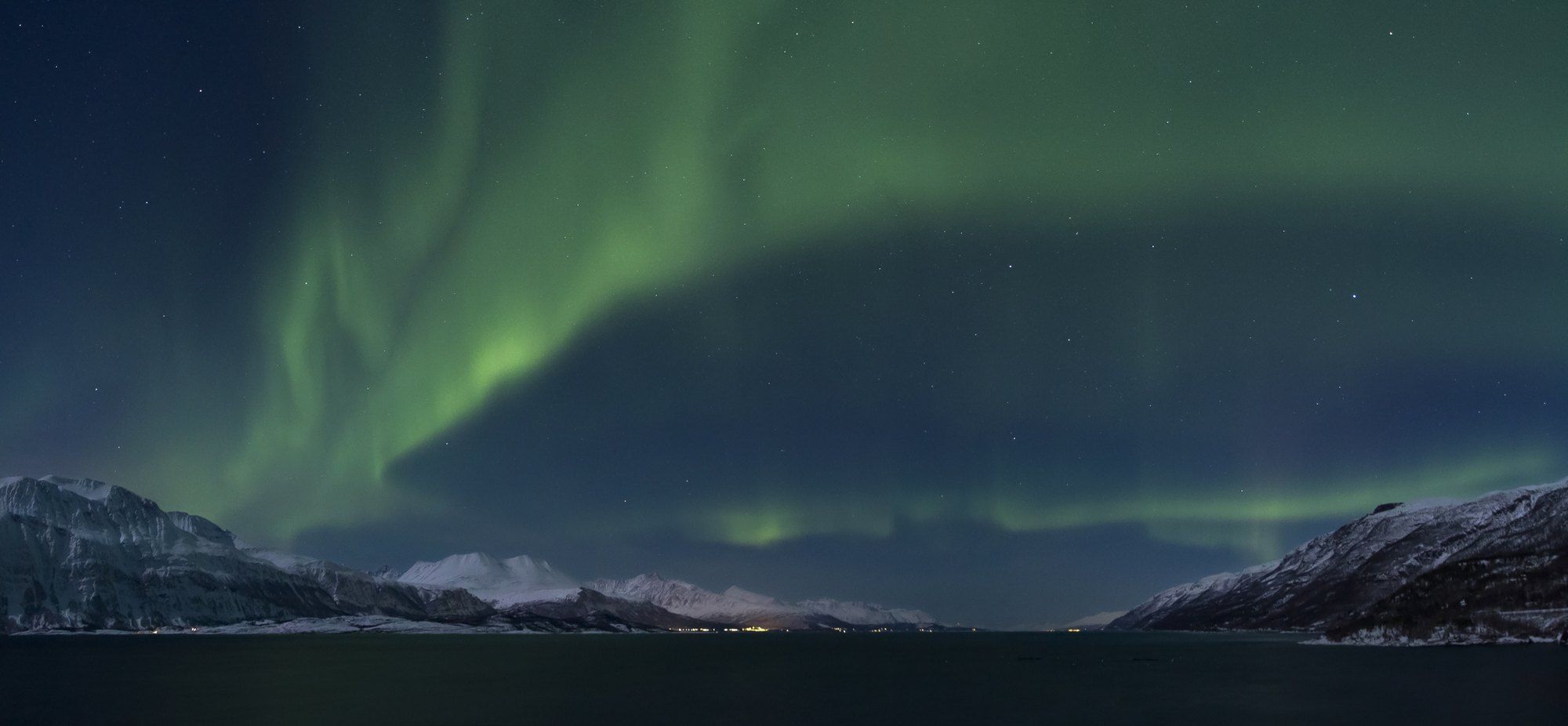
Tromsø has been watching the sky for a long time. The Norwegian Institute of Cosmical Physics was set up here in 1928, and its long series of observations of the aurora, the magnetic field and the ionosphere are still kept up today by Tromsø Geophysical Observatory at UiT, the Arctic University of Norway. Since 1971 the university’s Auroral Observatory has stood high above the town by the lake Prestvannet, surrounded by woodland.
The reason is simple. Tromsø lies inside the auroral zone, the belt around the magnetic pole where the northern lights are seen most often. On a clear, dark night they can be overhead. The problem is the city itself. One of NOAA’s tips for seeing the aurora is to get away from city lights, and Tromsø is a city of bridges, harbours and lit streets. So people drive. Out over the bridges to Kvaløya, or east on the E8 towards Lyngen and Finland, looking for a gap in the cloud and a place to pull over.
What you are looking for
Visit Tromsø gives the season as late August to early April, and adds the two conditions that matter: clear skies and darkness. The aurora may be there in daylight too, NOAA’s Space Weather Prediction Center points out, but it is only visible when it is dark. The best displays, it says, usually come within an hour or two of local midnight, between 22:00 and 02:00. A full moon makes the aurora look fainter, though it does not change how bright it actually is.
The number everyone checks is the Kp index. It runs from 0 to 9 and measures geomagnetic activity over a three-hour period. At low values the auroral oval sits far north and the lights are dim; as Kp rises, the oval spreads towards the equator, by roughly 2 degrees of magnetic latitude per step, and the aurora grows brighter and more active. What no index can promise is a clear sky.
Cloud decides most nights. Yr, the weather service of the Norwegian Meteorological Institute and the broadcaster NRK, publishes its own aurora forecast up to three days ahead, plus a short-term nowcast. Its advice: the best conditions are a dark, cloudless sky; thin, high cloud can be transparent enough to see through, while low cloud is usually dense and blocks the view. That is why the hunt is a drive. You go where the forecast shows a hole in the cloud, and that can change while you are on the road.
The dark season
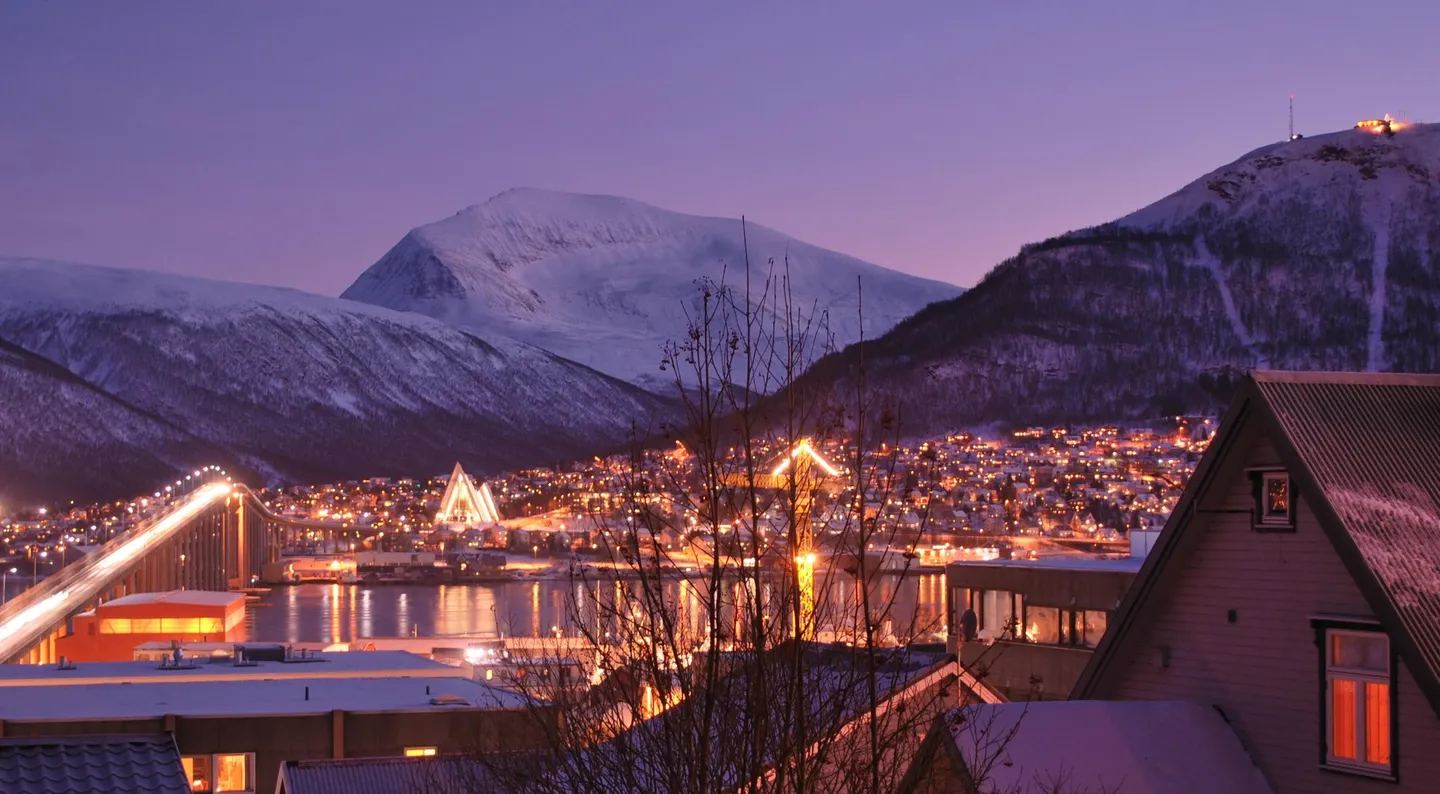
From about 27 November to 15 January, the sun does not rise over Tromsø at all. Visit Tromsø calls this the polar night. It is not pitch dark all day: around midday there is a spell of blue twilight. Because of the mountains around the city, the returning sun is usually not visible from the centre until later in January.
For a driver this means two things. There is a lot of dark in which to look for the lights, and almost all of the driving happens in it. Plan the long legs for the middle of the day, when there is light in the sky, and keep the evenings for the shorter runs out of town.
West: over the bridges to Kvaløya
The quickest way out of the lights is west. From Tromsøya, the island the city stands on, the Sandnessund Bridge crosses to Kvaløya. It opened in 1973 and is 1,220 metres long, with a main span of 150 metres, according to Store norske leksikon. To the east, the Tromsø Bridge of 1960 — 1,036 metres long and 36 metres high in the middle — crosses to the mainland and the Arctic Cathedral. Designed by Jan Inge Hovig, the church was consecrated in 1965.
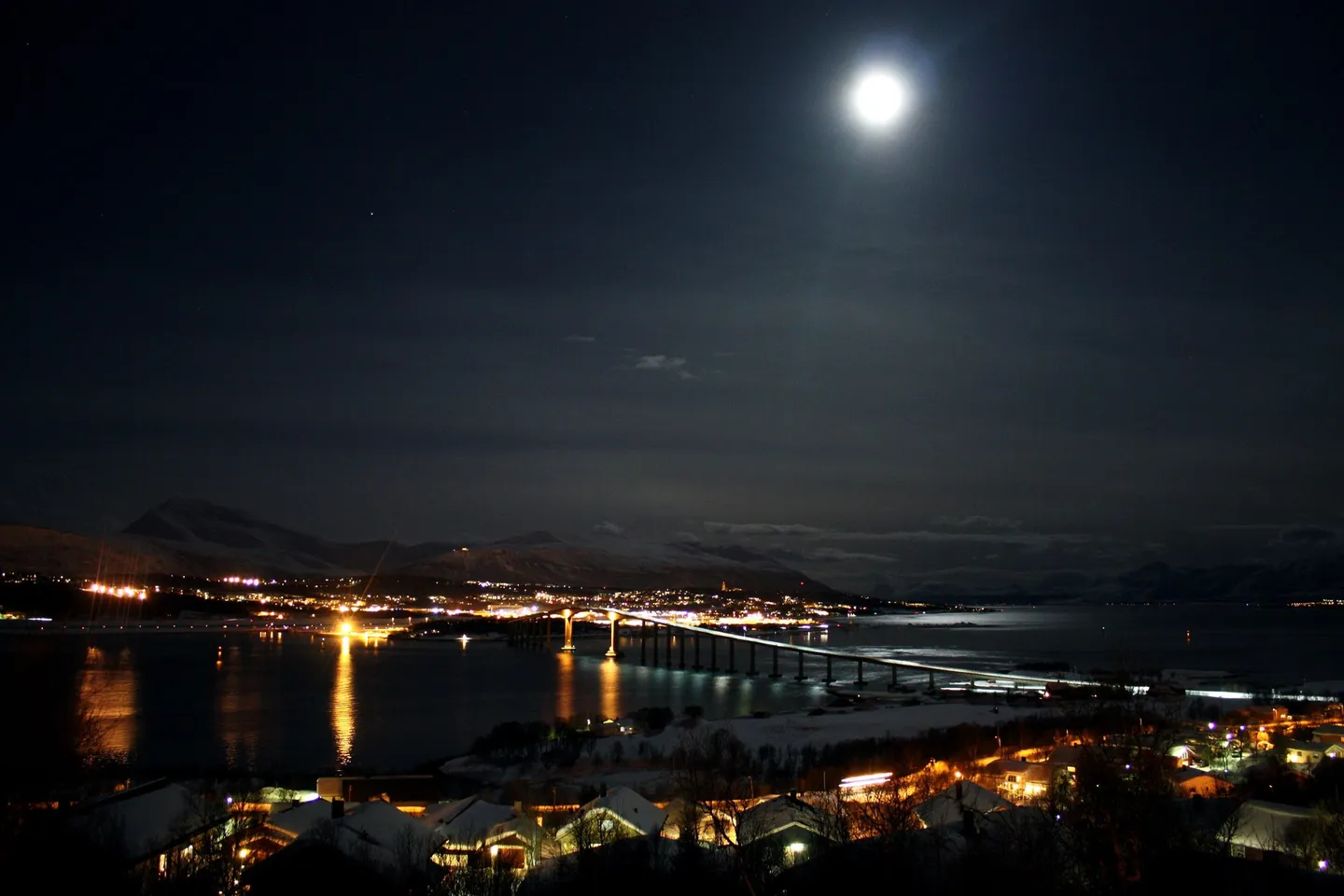
Kvaløya is a large, mountainous island with the city’s glow on one side and open sea on the other. On our three-day route, the first day goes to Ersfjordbotn, a small settlement at the head of a fjord ringed by steep peaks and one of the easiest dark places to reach from Tromsø. If the forecast holds, the road continues to Sommarøy at the island’s western tip.
East: the E8, Lyngen and the road to Finland
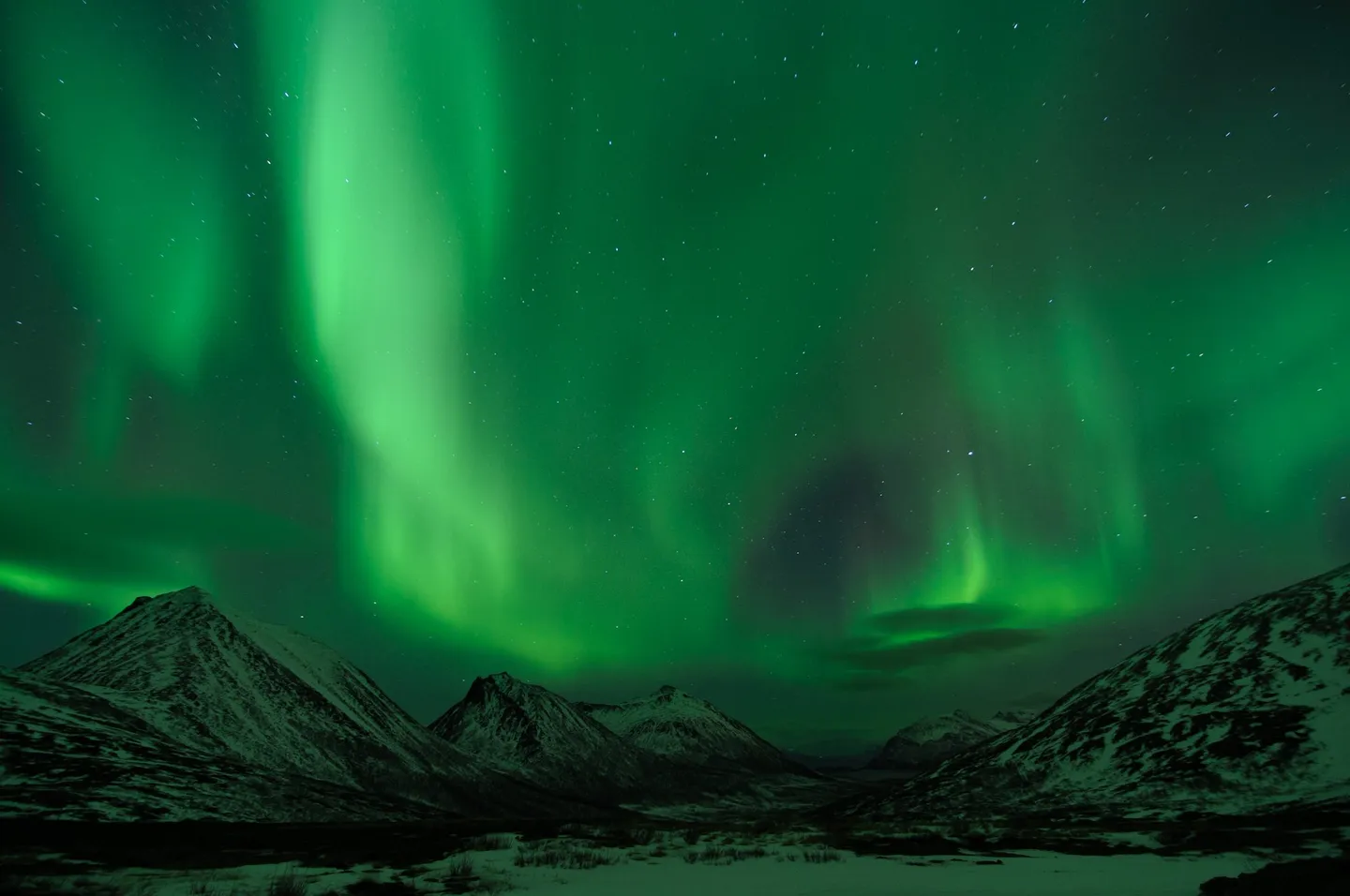
When the coast is under cloud, many people go inland. The E8 runs from Tromsø to Nordkjosbotn, where it joins the E6 as far as Skibotn, on the Lyngen fjord. On the way, the turn-off for Breivikeidet leads to the ferry across the Ullsfjord to Svensby and into the Lyngen Alps. Store norske leksikon describes the range as almost 80 km long but never more than 15 km wide, with about 140 glaciers; its highest summit, Jiehkkevárri, is 1,834 metres high and the highest mountain in Troms.
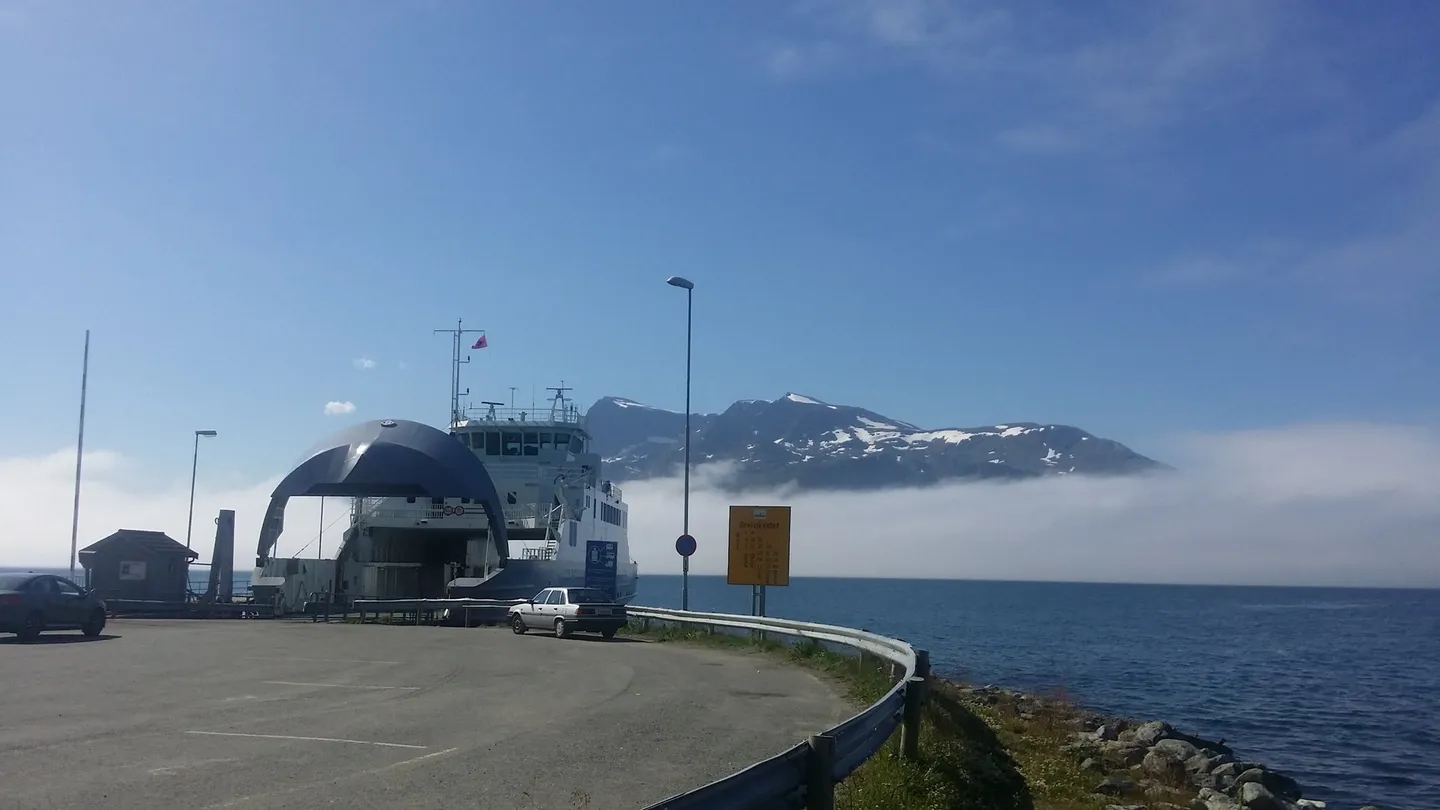
The crossing between Breivikeidet and Svensby takes about 20 minutes, and the Lyngen ferries run all year, Visit Tromsø says. You cannot reserve a place. Check the current timetable before you set out, because missing the last boat on a winter night means a long drive round.
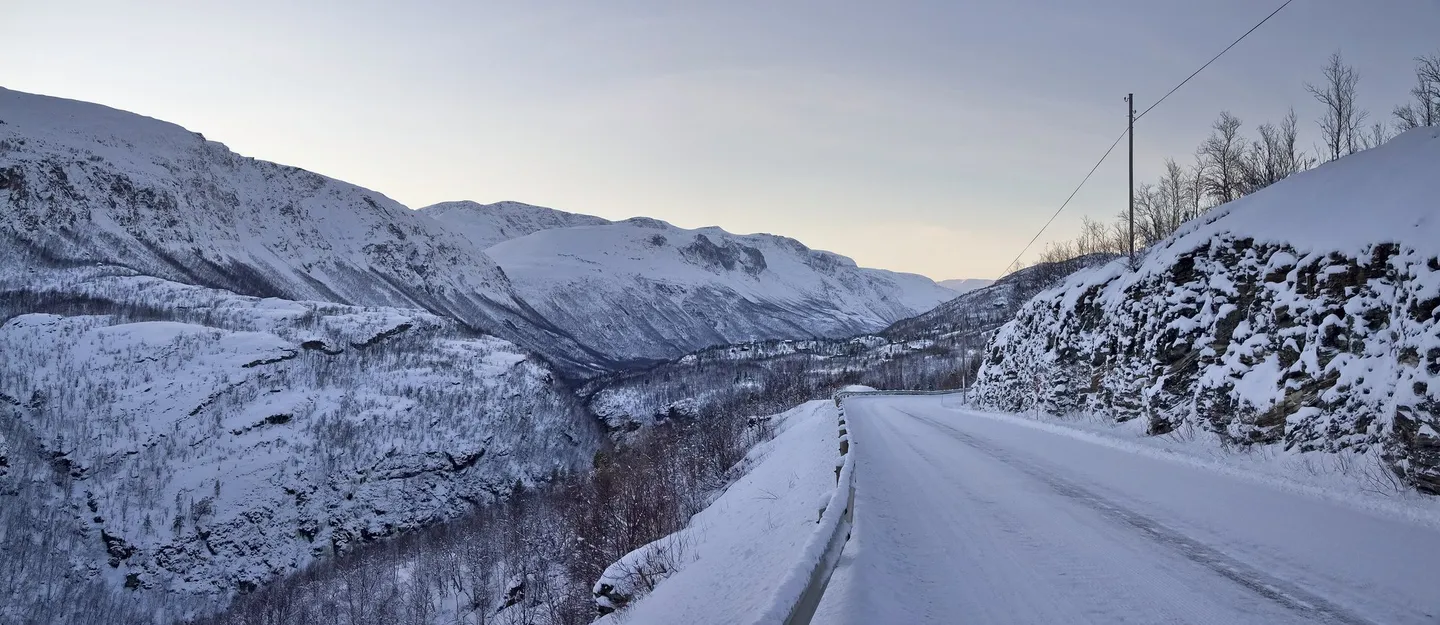
From Skibotn, the E8 climbs Skibotndalen to the Finnish border and on to Kilpisjärvi. Tour companies run aurora trips from Skibotn and switch to Kilpisjärvi when conditions there are better, which is the whole logic of the chase in one sentence. The road itself deserves respect. Statens vegvesen, the Norwegian road authority, describes it as narrow, with poor alignment and unfavourable gradients over much of its length, and as an important freight route between northern Norway and Finland where heavy vehicles struggle, especially in winter.
Where not to stop
The commonest mistake has nothing to do with the sky. Someone sees green over the fjord, brakes and stops on the road. Norway’s traffic rules forbid stopping on a blind bend, in a tunnel, on the crest of a hill or anywhere else where the view is poor, and within 5 metres of a junction. On a dark, narrow road in snow, those places are everywhere.
Visit Tromsø’s guidelines for aurora tourism ask drivers to watch where they stop and to let others pass. They also ask visitors to respect the lay-bys and stopping places along the road: lorry drivers and other professional drivers often use them for their compulsory rest. Do not walk in the road — the roads in the north, the guidelines say, are dark and winding with a lot of traffic — and wear a reflective vest when you get out. Do not walk through people’s gardens for a better view.
Reindeer and moose
The same guidelines warn that moose and reindeer often appear on the road. Statens vegvesen adds that in areas with many reindeer, road salt can draw them onto the carriageway, and that herd animals rarely come alone: if you see one, brake gently and expect more. In 2023 it warned drivers in the north to slow down and sound the horn for reindeer in tunnels, but not to leave the car.
If you do hit an animal, it is not a crime; failing to report it is. Call the police on 02800, secure the place with a warning triangle and hazard lights, and do not try to put the animal down yourself unless the police have said you may.
Before you go
Tyres. Norwegian rules require tyres in good condition and suited to the vehicle and the road surface in every season, with a tread depth of at least 3 mm. In Nordland, Troms and Finnmark, studded tyres are allowed from 16 October to 30 April, and outside those dates when conditions demand it. Confirm what your rental car has when you book.
Check the road and the weather. Statens vegvesen’s advice is to always check traffic reports and the weather forecast before you set off, on vegvesen.no/trafikk, and to call the road traffic centres on 175 if you come across a dangerous situation. If a road is running in convoy, never overtake the lead vehicle, do not turn back before the end, and do not leave your car if the convoy stops.
Pack for a long night. The road authority suggests warm clothes, a torch, a blanket and food, plus a shovel, a tow rope and jump leads. Fill up in town; filling stations thin out quickly once you leave.
No guarantees. The aurora is never certain, and nobody can promise it for a given night. The sources agree on the two conditions it needs: darkness and a clear sky.
On the way. Our three-day Tromsø loop crosses Kvaløya on the first day and takes the Ullsfjord ferry into the Lyngen Alps on the second, with evenings free to drive out again if the forecast is good.
Drive it yourself
The day-by-day route, real costs and where to sleep are in the itinerary. The planner draws it on the map from wherever you start.
Sources
- Visit Tromsø — Northern lights
- Visit Tromsø — Winter in Tromsø
- Visit Tromsø — Retningslinjer for nordlysturisme
- Visit Tromsø — Express boat and ferries
- NOAA Space Weather Prediction Center — Tips on viewing the aurora
- Yr — Aurora forecast on Yr
- UiT The Arctic University of Norway — About Tromsø Geophysical Observatory
- UiT Arkitekturguide — Nordlysobservatoriet (Auroral Observatory)
- UiT Arkitekturguide — Tromsøbrua (Tromsø Bridge)
- Store norske leksikon — Sandnessundbrua
- Store norske leksikon — Ishavskatedralen
- Store norske leksikon — Lyngsalpene
- Statens vegvesen — E8 Riksgrensen–Skibotn
- Statens vegvesen — Nå er det tid for å skifte til vinterdekk (October 2024)
- Statens vegvesen — Vinterkjøring
- Statens vegvesen — Påkjørsel av dyr
- Statens vegvesen — Vær obs på reinsdyr og sau i tunnel (June 2023)
- Lovdata — Forskrift om kjørende og gående trafikk (trafikkregler), § 17
Every fact in this story comes from the sources above. Where they disagree, the text says so. Found a mistake? Write to hello@roadcutco.com.