The Teide road: a drive through the caldera of Las Cañadas
From the warm north coast of Tenerife, the TF-21 climbs through pine forest into a volcanic crater about 16 kilometres long, past the Roques de García to the foot of the highest mountain in Spain. In winter it can be closed by snow.
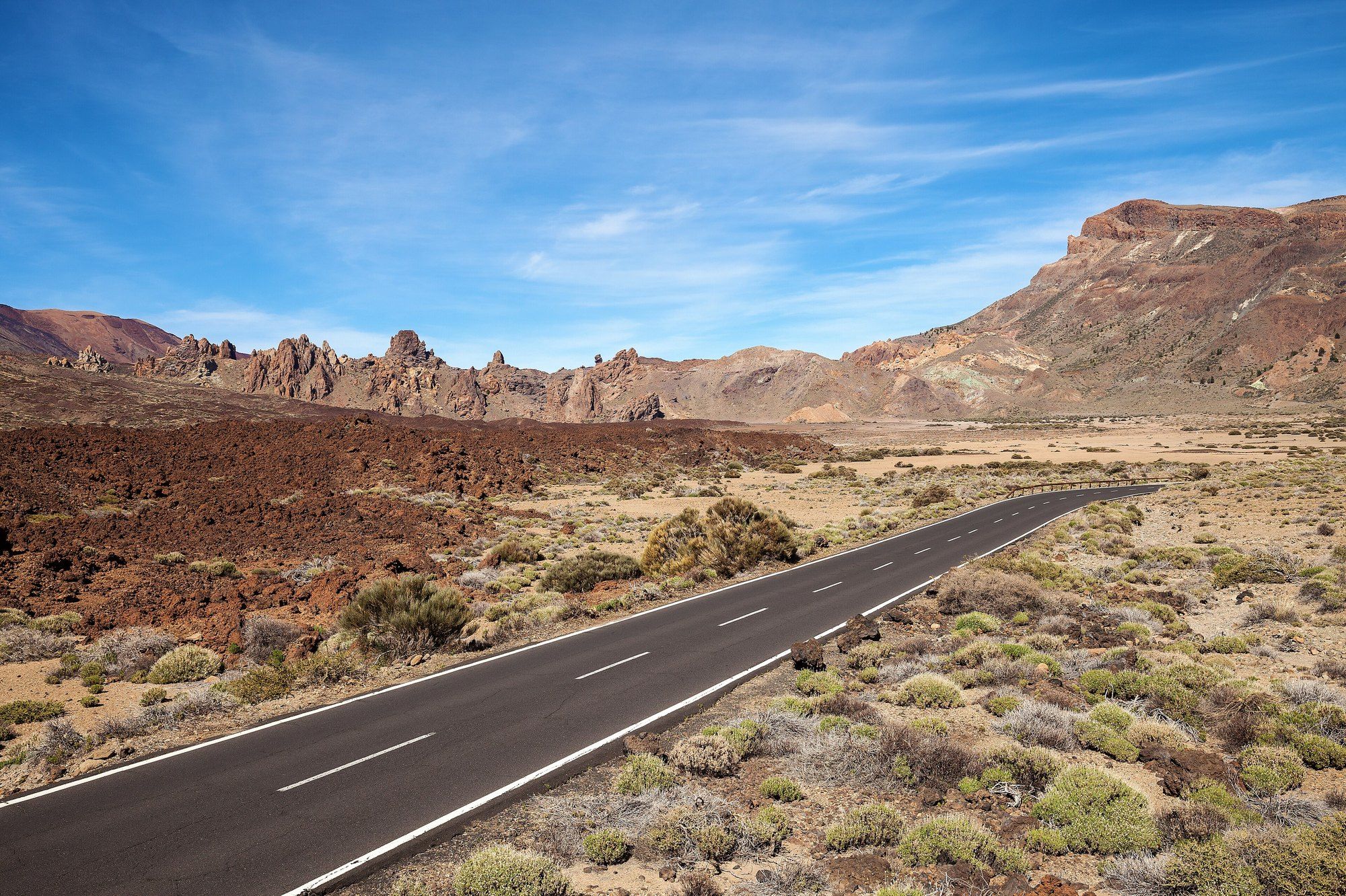
On 24 August 1492, according to Columbus’s son Fernando Colón, sailors on the first voyage to the Americas saw flames rising from the mountain in the middle of Tenerife. The Guanches, who lived on Tenerife before the Spanish conquest, called it Echeyde — the dwelling of Guayota, the evil one. Today it is Teide, and at 3,715 metres it is the highest mountain in Spain.
You can drive most of the way up. From La Orotava, above the north coast, the TF-21 climbs out of the town and through the pine forest into a crater so large that it holds a whole landscape of its own: lava fields, sandy plains, rock towers and even a hotel. This is the caldera of Las Cañadas, and the road across its floor is one of the strangest drives in Spain.
Four ways in
Four roads lead into Teide National Park, and between them they run for more than 47 km inside it, according to the park’s guide to its viewpoints. The TF-21 comes up from La Orotava in the north and enters the park near El Portillo. The TF-24 follows the island’s spine from La Laguna through La Esperanza and joins it at El Portillo. From the south, the TF-21 climbs from Granadilla through Vilaflor and enters the park at the Barranco del Dornajito. From the west, the TF-38 comes up from Chío and meets the TF-21 at Boca de Tauce.
On the TF-24, before the junction, the viewpoints look down on the Orotava valley and, often, on the mar de nubes — the sea of cloud that tends to cover the north of the island.
The park’s own warning about all of these roads is short: they are narrow and panoramic, and can be dangerous, especially in bad weather.
The crater
Between El Portillo and Boca de Tauce, the TF-21 crosses the caldera for about twenty kilometres by its kilometre posts. Volcano Teide, the company that runs the cable car, describes Las Cañadas as an elliptical depression measuring 16 by 11 km, formed about 198,000 years ago when part of the island slid north into the sea; other scientific sources give different dimensions, and how the caldera formed is still argued over. Teide itself, the same source says, began to grow inside it about 175,000 years ago.
On one side of the road rises Teide; on the other runs the wall of the caldera. From the Arenas Negras viewpoint near El Portillo, the park guide says, you can watch the wall gain height until it reaches 330 metres. At the Minas de San José, at kilometre 38.5, the road crosses old open-cast workings where pumice was dug, with a long view across the caldera to the south.
The Roques de García
At kilometre 46.5 is La Ruleta, at the Roques de García — by the park’s account the most visited viewpoint in the national park. From its platforms you look at the western wall of the caldera, at the twin volcano of Teide and Pico Viejo, and down on the Llano de Ucanca, the largest of the cañadas, the flat sandy floors at the foot of the wall. The basalt tower called La Catedral rises almost vertically 144 metres above the plain.
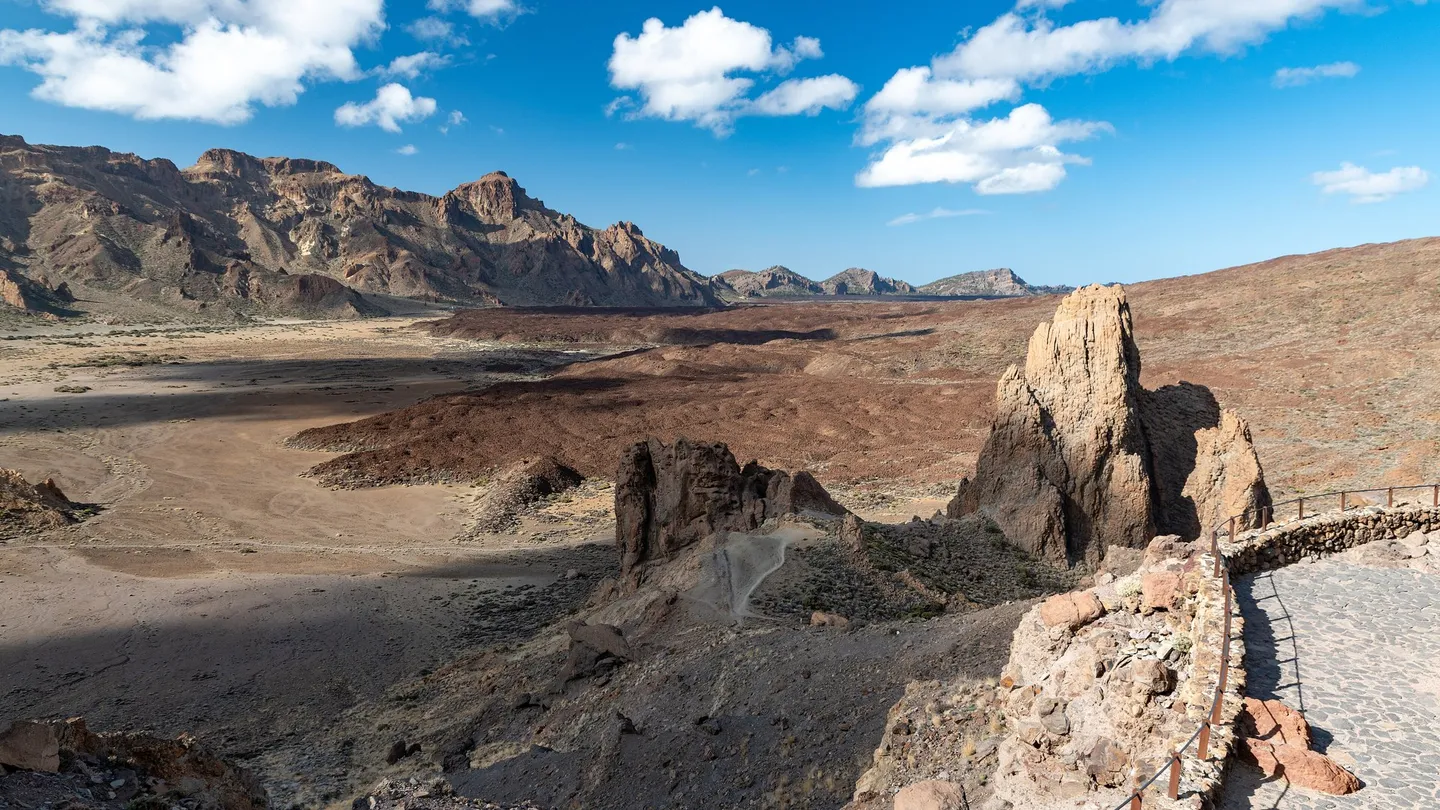
Close to the Roques stands the Parador de Las Cañadas del Teide, a hotel inside the park and the end of bus line 348.
Teide and Pico Viejo
Teide has a twin. Pico Viejo, to its west, has a crater 800 metres across and 200 metres deep, according to the park. Alexander von Humboldt came here in June 1799 and was the first to study the park’s plants.
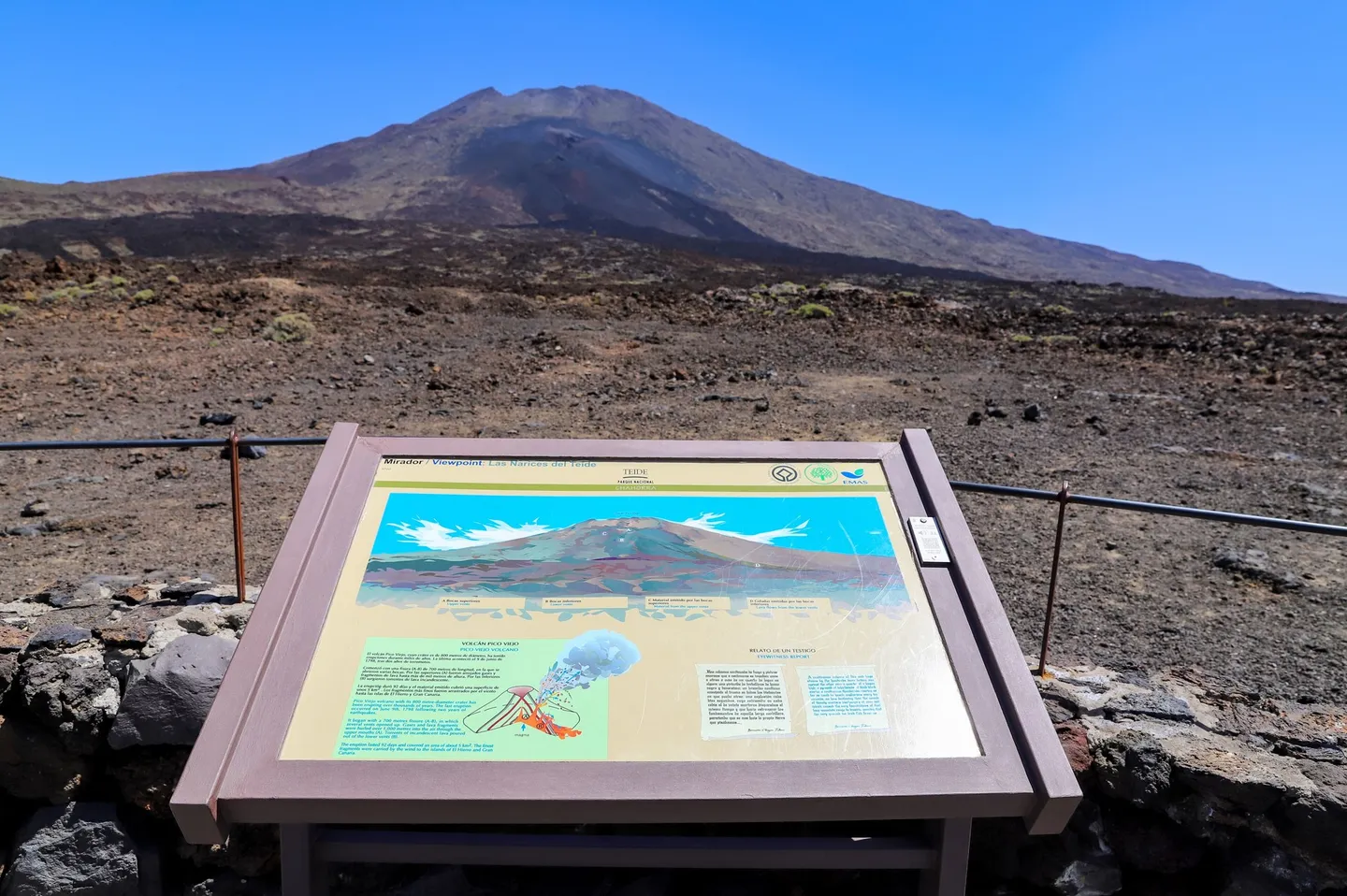
A year before he came, in 1798, the side of Pico Viejo split open. The eruption formed the Narices del Teide — Teide’s nostrils — and poured out about twelve million cubic metres of lava over three months. The park calls it the last eruption within its boundaries and the longest of all the historic eruptions on Tenerife. You can see the lava from the Narices del Teide viewpoint, at kilometre 3.2 of the TF-38.
The cable car
The drive ends at the base station of the cable car, at kilometre 42.8 of the TF-21 and 2,356 metres up. The cable car was first planned in 1930. Building started in 1963, took eight years in a place where snow and cold often confined the work to the base station, and the line opened in July 1971. It is almost 2.5 km long and climbs about 1,200 metres to an upper station at 3,555 metres, in about eight minutes. Since September 2024, the operator says, it has run on 100 per cent renewable energy.
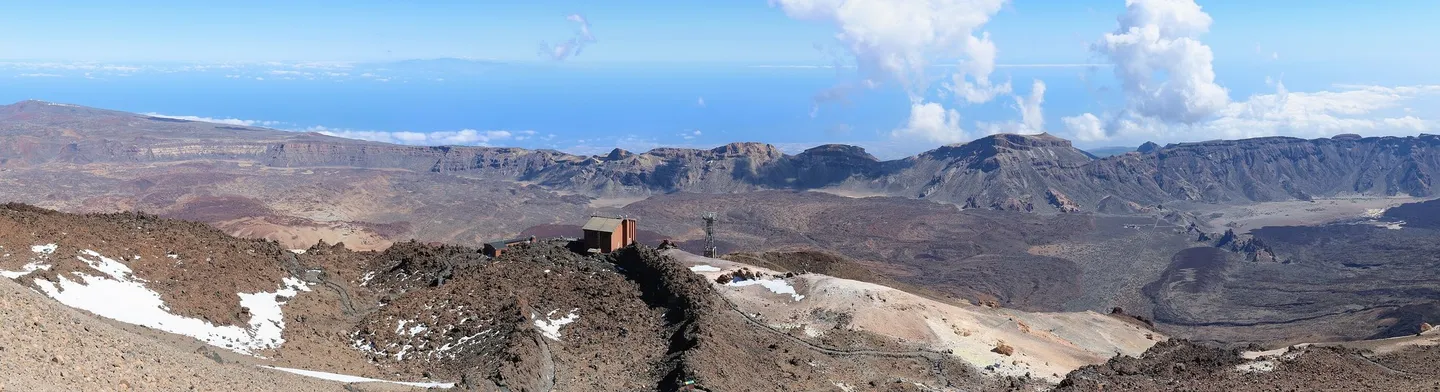
From La Rambleta, around the upper station, short paths lead to viewpoints over Pico Viejo and the whole caldera. The operator warns that the cable car may not run in bad weather, and advises checking the forecast a day before.
The last 160 metres
The summit is 160 metres higher than the upper station, at the end of path number 10, the Telesforo Bravo. You need a booking for it. Since 19 January 2026, the Cabildo de Tenerife — the island government, which has taken over the running of the park — also charges for it, the public broadcaster RTVC reported: between 09:00 and 17:00, adults from outside the Canary Islands pay €15 and residents of the other islands €6, while Tenerife residents and children under 14 go free. The long climb from Montaña Blanca to La Rambleta, path number 7, costs visitors from outside the Canaries €6 on weekdays and €10 at weekends and on holidays, between 09:00 and 15:00. Bookings are made on the Cabildo’s Tenerife ON platform.
The park confirmed the details to Roadcut in October 2026. The same Tenerife ON platform handles every permit for the upper part of Teide and Pico Viejo: path number 10 to the summit; path number 7, or number 9 by way of Pico Viejo, if you walk up to La Rambleta instead of taking the cable car; and bivouacs at the four authorised sites above 2,500 metres. Places open about 49 to 56 days ahead — around 7 a.m. on the Monday 49 days before the week you want — and not earlier. The cable car ticket is separate and does not replace the summit permit; many people book the cable car for a few minutes before their permit slot. Tenerife ON also posts alerts and path closures. Walking up from the road and bivouacking, the park adds, are only for experienced mountaineers with the right equipment.
The rules keep changing. In October 2026, Diario de Avisos reported that three more paths would need a booking and that the time slots on the Telesforo Bravo would be shortened from two hours to 90 minutes; walking a path that needs a booking without one can be fined up to €600. Check the current conditions on Tenerife ON before you go — the cable car operator’s own website still described the permit as free when we checked.
Snow on the TF-21
The coast below is warm in winter. The road climbs to 2,356 metres at the cable car, and up there snow and ice close it. On 22 December 2024 the Cabildo closed the TF-21 from La Orotava, the TF-24 from La Esperanza and the TF-38 from Chío because of ice and snow on the carriageway. The next day, elDiario.es reported, the TF-21 was still shut between kilometre 16, at Aguamansa, and kilometre 43, at the cable car, and the TF-24 between kilometres 24 and 43.
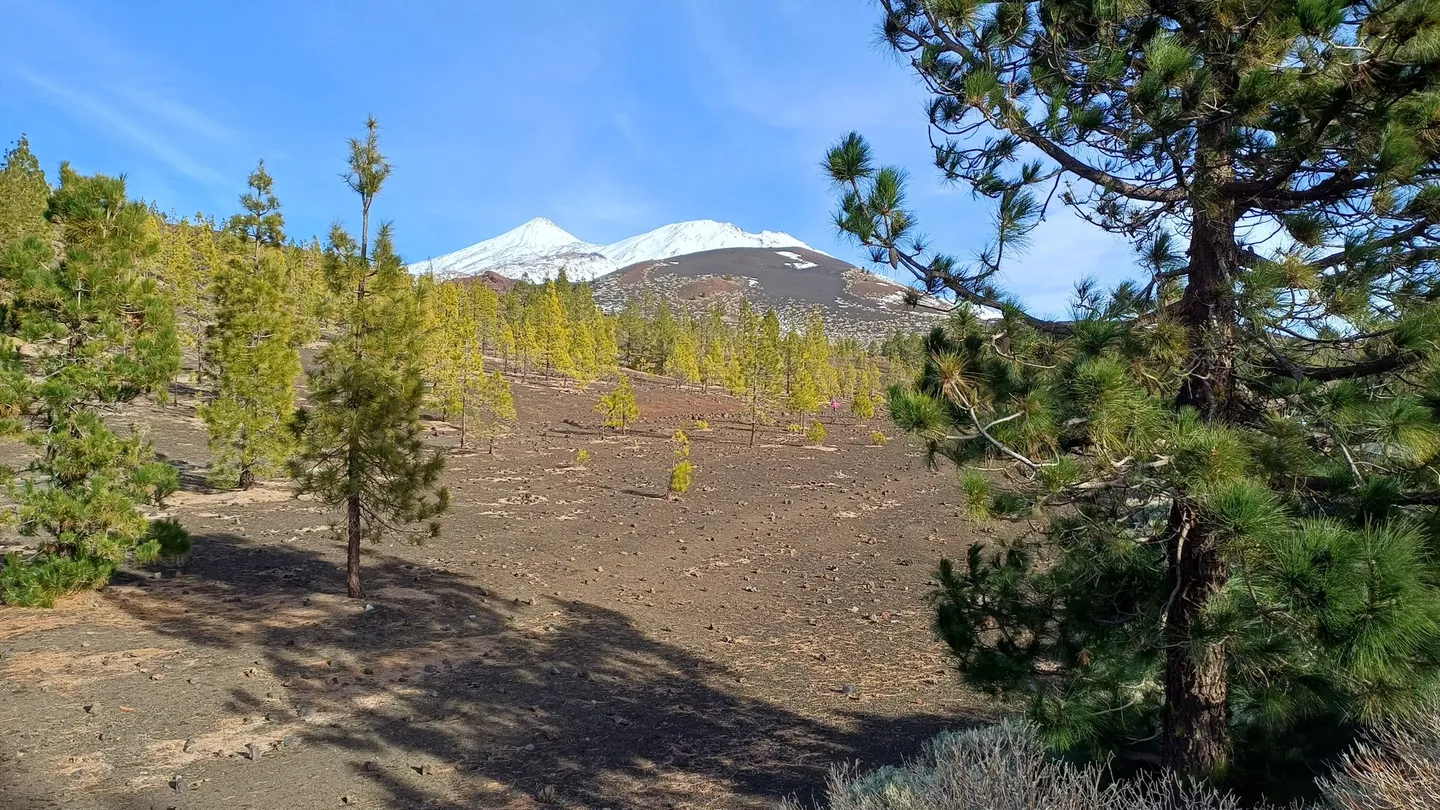
A year later, during the storm Emilia in December 2025, the snow brought crowds and the Cabildo put the island’s emergency plan into effect. When it was lifted on 22 December, RTVC reported, the TF-21 between El Portillo Alto and the cable car was still closed, motorhomes and caravans were still banned, and stopping or parking along the road and at the viewpoints was forbidden except in marked places. In March 2026 the TF-21 and TF-24 were closed again for ice and reopened after the Cabildo’s road crews had inspected them.
After dark
The sky above Teide is protected by law. Law 31/1988 of 31 October 1988, written to protect the astronomical quality of the observatories on Tenerife and La Palma, covers light pollution, radio interference, air pollution and flight routes, the Instituto de Astrofísica de Canarias says. The Teide Observatory, mainly used to study the Sun, stands at 2,390 metres at Izaña, just off the TF-24; its first telescope was set up in 1964. The park itself received Starlight certification in 2013.
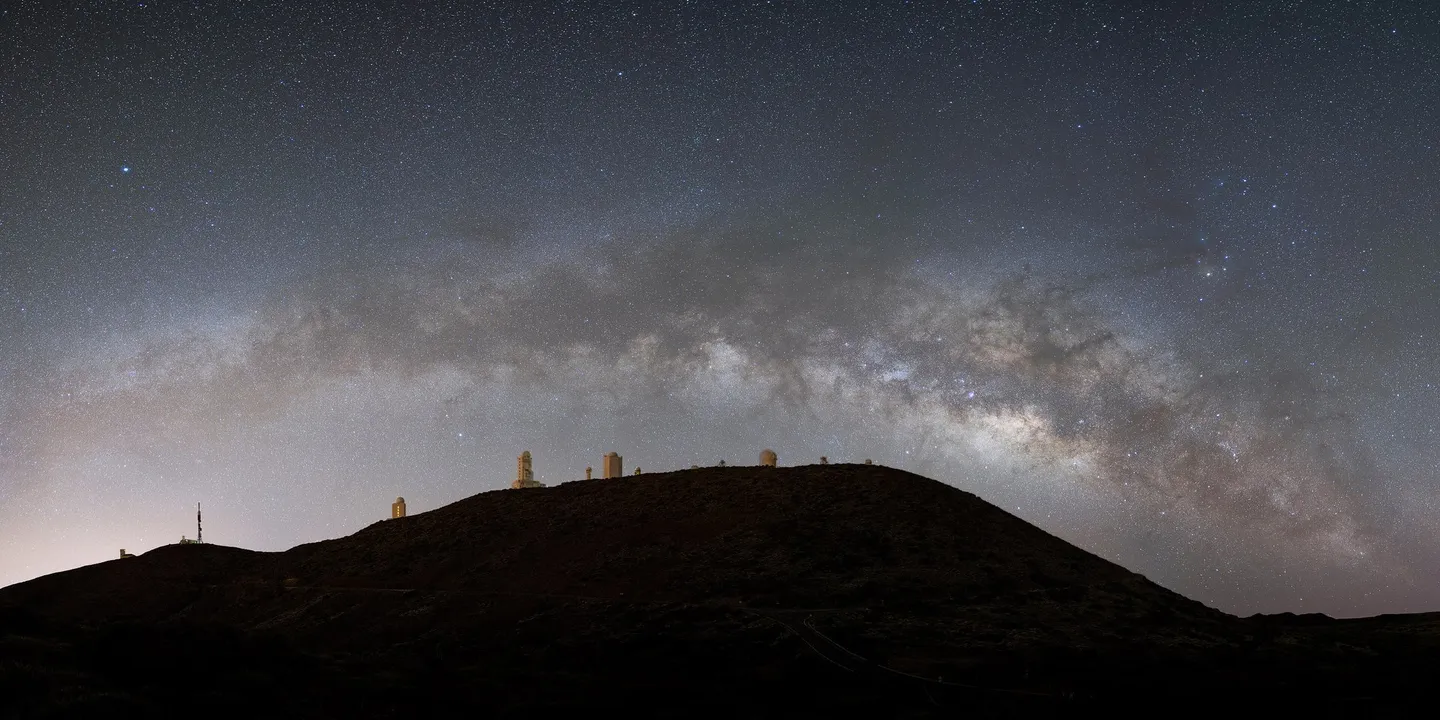
Stargazing has its own crowds. On the nights of 12 and 13 August 2026 — the peak of the Perseids and the day of the solar eclipse — the Cabildo set up control points on the TF-21, TF-24 and TF-38 from 17:00 to 05:00, letting in buses but not private cars. On past Perseid nights, RTVC reported, more than 2,000 vehicles had been in the park at the same time.
Five million visitors
Teide is the most visited national park in Spain: 5,113,021 visitors in 2025, according to the national parks agency, more than twice as many as the next, Sierra de Guadarrama.
The Cabildo wants fewer cars. Plans it presented in May 2026 include 500 parking spaces that would have to be booked in advance, an eco-tax for rental cars, access control at the main entrances from the end of 2026 and, from 2027, a network of shuttle buses from the coast. None of it was in force when RTVC reported it.
Before you go
No toll. There are no tolls on the roads into the park. The fees described above are for the summit paths; the paid parking the Cabildo has planned was not in force when it was reported.
Open all year — except in snow. In winter, check road status with the Cabildo de Tenerife before you set out; the TF-21, TF-24 and TF-38 can be closed for hours or days.
Bus. The park lists two TITSA lines: 348 from Puerto de la Cruz to the Parador via La Orotava and El Portillo, and 342 from Costa Adeje to El Portillo via Vilaflor and Las Cañadas. Check the return times before you go.
On the way. On our three-day Tenerife loop from Santa Cruz, the first day climbs through La Orotava into the national park, with time for the Roques de García and the cable car.
Drive it yourself
The day-by-day route, real costs and where to sleep are in the itinerary. The planner draws it on the map from wherever you start.
Sources
- Parque Nacional del Teide — Ficha técnica
- Parque Nacional del Teide — Historia
- Parque Nacional del Teide — Accesos
- Parque Nacional del Teide — Asómese y conózcanos: guía para miradores (MITECO)
- OAPN / MITECO — Visitantes en la Red de Parques Nacionales, anualidad 2025 (May 2026)
- Volcano Teide — A geological park
- Volcano Teide — Teide cable car
- Volcano Teide — History of the Teide cable car
- RTVC — Hasta 25 euros pagarán los visitantes que suban al Teide en 2026 (1 October 2025)
- RTVC — El Cabildo de Tenerife activa la ecotasa para los senderos más emblemáticos del Teide (18 January 2026)
- Diario de Avisos — Senderos del Teide: reserva y multas (14 October 2026)
- elDiario.es — El Cabildo de Tenerife cierra los accesos al Teide por hielo y nieve en la calzada (22 December 2024)
- elDiario.es — El Cabildo de Tenerife mantiene cerrados los accesos al Teide por hielo y nieve (23 December 2024)
- RTVC — Tenerife desactiva el plan de emergencias del «Operativo Nevadas» en el Teide (22 December 2025)
- Diario de Avisos — Reapertura de las carreteras del Teide, TF-21 y TF-24 (5 March 2026)
- Instituto de Astrofísica de Canarias — Teide Observatory
- Instituto de Astrofísica de Canarias — The Law that protects the sky of the Canary Islands celebrates its twenty-fifth anniversary
- RTVC — Restringen el acceso al Teide durante las noches de las Perseidas y el eclipse (August 2026)
- RTVC — El Cabildo de Tenerife plantea limitar el uso del vehículo privado en el Teide (7 May 2026)
- Diario de Avisos — Oficina del Parque Nacional del Teide: integración del personal transferido (15 July 2026)
Every fact in this story comes from the sources above. Where they disagree, the text says so. Found a mistake? Write to hello@roadcutco.com.