Mallorca Road Trip: the Serra de Tramuntana on the Ma-10 in 4 Days
A 292 km loop from Palma: the Ma-10 mountain road from Andratx to Pollença through Valldemossa, Deià and Sóller, the hairpins down to Sa Calobra, Lluc and Cap de Formentor, with the seasonal rules for Formentor and Sa Calobra.
Rough estimate — fuel + nights at typical rates. Get an exact figure in the calculator.
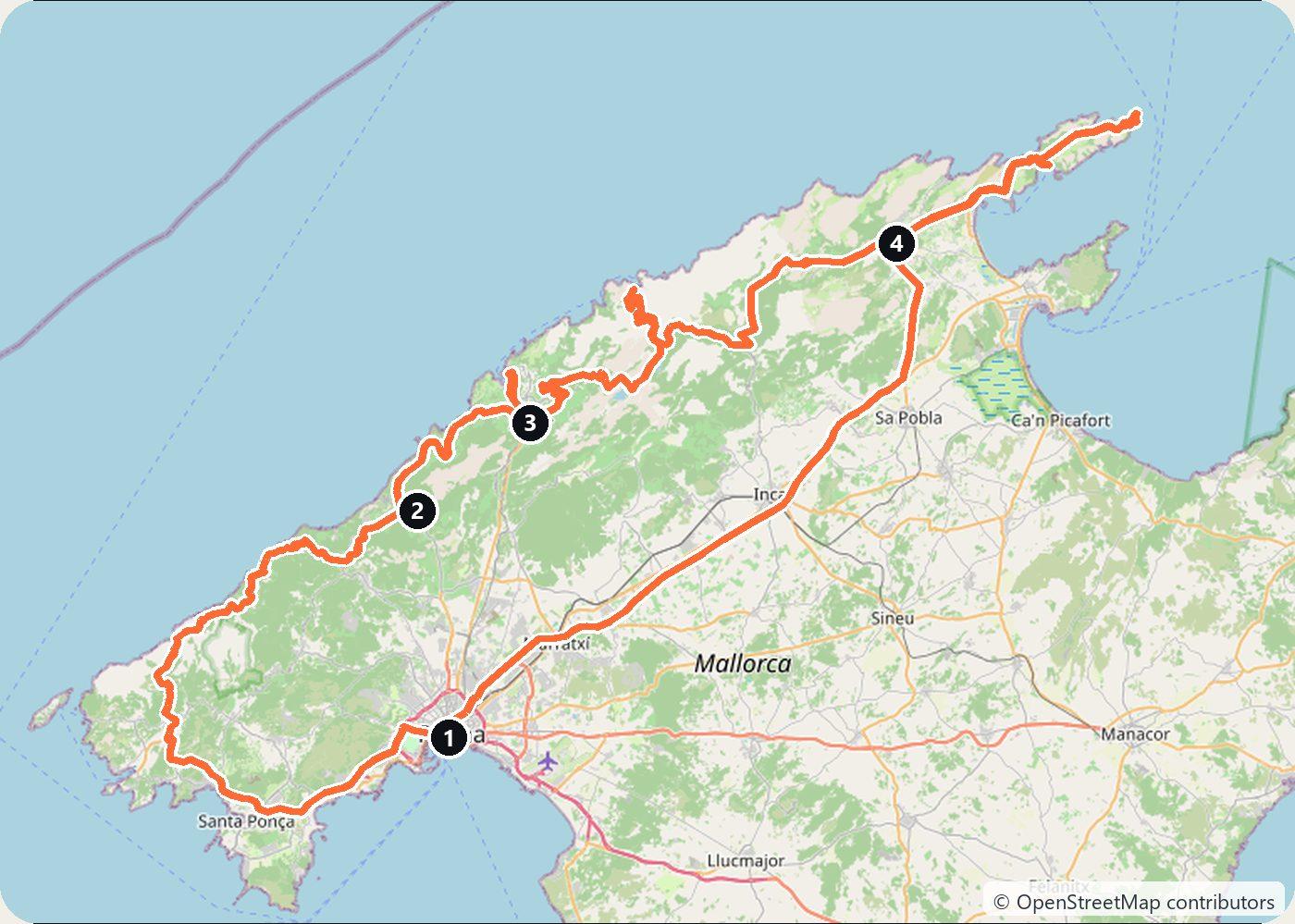
Most visitors to Mallorca stay on the beaches of the south and east. The north-west coast is a wall of limestone mountains, the Serra de Tramuntana, and one road runs along almost all of it. The Ma-10 starts in Andratx in the south-west and ends in Pollença in the north-east, about 117 km of bends, stone villages, terraces and sea views. UNESCO listed the range as a World Heritage cultural landscape in 2011. This trip drives the whole Ma-10 in four days from Palma. It adds the most famous side road on the island, the hairpins down to Sa Calobra, and the road out to the lighthouse on Cap de Formentor. The loop is about 292 km.
You drive on the right, and there are no tolls anywhere on the route. Most people pick up the car at Palma airport (PMI), about 12 km east of the city centre. Before you go, know about two places with rules for cars. At Cap de Formentor, private cars are kept off the road in summer. In 2026 the rule ran from 15 May to 18 October, 10:00 to 22:00, and the DGT, Spain’s traffic authority, sets the dates again every year (details on Day 4). At Sa Calobra, the car park at the bottom is paid. Cars cannot go past the car park into the little port: a camera at the entrance fines vehicles without a permit.
The Tramuntana is also a favourite with road cyclists, and in spring the climbs are full of them. Spanish rules say you must leave at least 1.5 m when you overtake a cyclist. You may cross a solid line to do it, but only when you can see far enough ahead and nothing is coming.
Day 1 — Palma to Valldemossa via Andratx (70 km)
Leave Palma on the Ma-1 motorway west to Andratx, where the Ma-10 begins. The road climbs at once into the hills and drops to the coast. The first village is Estellencs, a cluster of stone houses on terraces above the sea.
A few kilometres on, stop at the Mirador de ses Ànimes, just before Banyalbufar. Its 16th-century watchtower stands on a rock above the sea. Towers like this one were built to watch the coast for pirate ships. You can park beside the Ma-10 and walk a few steps to it. Then comes Banyalbufar, where the whole slope down to the sea is cut into dry-stone terraces. Farmers built terraces like these over centuries, and they are a large part of why UNESCO listed the range.
The Ma-10 then turns inland to Valldemossa. Its great sight is the Cartoixa de Valldemossa, a former Carthusian monastery. The composer Frédéric Chopin and the writer George Sand spent the winter of 1838–39 in one of its cells. Chopin finished his Preludes, Op. 28, there. Today the “Chopin cell” is a small museum, and it keeps his Pleyel piano. Sleep in Valldemossa.
Day 2 — Valldemossa to Sóller via Deià (32 km)
This is a short day, so take it slowly. The Ma-10 runs along a ledge high above the sea to Son Marroig. The estate belonged to the Austrian Archduke Ludwig Salvator, who fell in love with Mallorca and bought land along this coast. Below it, the rocky Sa Foradada peninsula sticks out into the sea, with a hole about 18 m wide in it. The viewpoint at Son Marroig is the best place to see it, especially at sunset. The path down to the peninsula crosses private land, and you pay to enter the estate.
A few minutes further on is Deià, a village of honey-coloured stone on a hill under the mountains. The English poet Robert Graves first came here in 1929, and from 1946 he lived here until his death in 1985. He is buried in the small churchyard at the top of the village. His house, Can Alluny, is now a museum, a short walk from the centre on the road to Sóller. It opens five days a week, so check the times before you go.
The road then winds down into the orange groves of Sóller. On the main square, the church of Sant Bartomeu has a Modernista front from 1904, by Joan Rubió, a follower of Gaudí. Rubió also designed the Modernista Banco de Sóller building of 1912. The wooden Sóller train has run over the mountains to Palma since 1912. A tram connects the town with Port de Sóller, the harbour 3 km away. Drive down to the port for the evening light on the bay, then come back up. Sleep in Sóller.
Day 3 — Sóller to Pollença via Sa Calobra (80 km)
This is the big mountain day. The Ma-10 climbs out of Sóller in long bends towards Puig Major (1,436 m), the highest mountain in Mallorca, and passes the two reservoirs of Cúber and Gorg Blau. Watch for the turn to Sa Calobra, the Ma-2141.
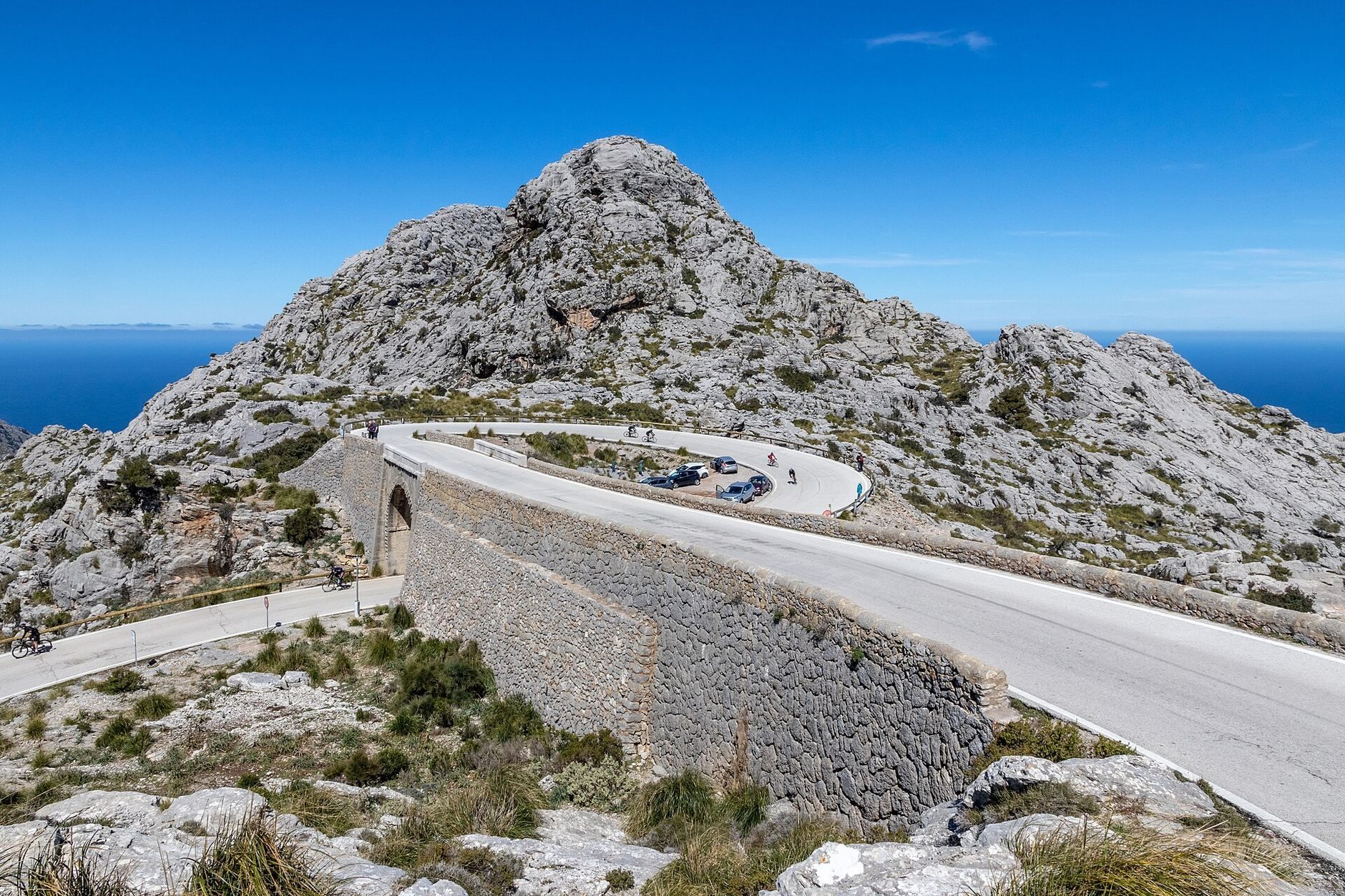
The road down was built in the early 1930s by the engineer Antonio Parietti. From the pass of Coll dels Reis (682 m) it drops about 10 km to the sea in a chain of hairpins. Just below the pass is the Nus de sa Corbata, the “tie knot”: the road turns almost a full circle and passes under itself through a stone arch. Stop at the viewpoint there for the classic picture. Then go down to Sa Calobra, park in the paid car park and walk the rest. A path through tunnels in the rock leads to the mouth of the Torrent de Pareis. Here the gorge comes out between cliffs onto a beach of pebbles. There are no facilities on that beach, so take water. The Ma-2141 is a dead end, so you drive the hairpins twice.
Coaches, vehicles over 4.5 tonnes and motorhomes may only enter the Sa Calobra zone between 11:00 and 13:30, and may leave only after 13:30. If you have a motorhome, those times apply to you. If you have a car, expect to meet coaches on the hairpins at those hours.
Back on the Ma-10, drive on to the Santuari de Lluc. The monastery sits in a basin at 525 m and has been a pilgrimage site since the 13th century, the most important in Mallorca. Its boys’ choir, Els Blauets, named after their blue robes, was founded in 1531. Parts of the sanctuary are closed to traffic, so use the car park. The last stretch of the Ma-10 drops to Pollença. The 365 steps of the Calvari climb from the town to a chapel on the hill. Sleep in Pollença.
Day 4 — Pollença to Palma via Cap de Formentor (110 km)
Drive 6 km to Port de Pollença and take the Ma-2210 onto the Formentor peninsula. Parietti built this road too, in 1925. The first stop is the Mirador Es Colomer, a viewpoint on top of sheer cliffs above the islet of Es Colomer. Then comes Platja de Formentor, the beach of the peninsula. At the end, the Cap de Formentor lighthouse has stood since 1863.
In summer the road has two zones. From the barrier at km 2, private cars may only drive as far as the car park at Formentor beach (km 8), and only while it has space. When it is full, the barrier closes. From the beach to the lighthouse, private cars are not allowed at all between 10:00 and 22:00. Instead, the TIB line 334 bus runs from Alcúdia and Port de Pollença to the lighthouse. It stops at Mirador Es Colomer, Formentor beach and Cala Figuera–Cala Murta. You can park for free on the service road of the Ma-2200 in Port de Pollença. Cars that drive in before 10:00 must be beyond km 8.6 by 9:58, or they are fined. Stopping anywhere on the road that is not marked as parking is also fined. Fines are €100–200. Outside the season you can drive all the way to the lighthouse.
From Port de Pollença the Ma-13 motorway takes you back across the island to Palma, about 62 km. If you return the car at the airport, the day is about 117 km.
Costs
Use the cost calculator to price fuel and nights for your dates. There are no tolls or vignettes on this route. Budget for accommodation, fuel for about 292 km (a lot of it in low gears), car rental and parking: the car park at Sa Calobra is paid. From 1 November to the end of February, if the Sa Calobra car park is full or closed, the town hall’s street parking there costs €2 for the whole day. Mallorca also charges a sustainable tourism tax per person and night, which your hotel adds to the bill. If you want to ride the tram from Sóller to the port, a single ticket is €10.
In bad weather the Serra has its own rules. In storms the Consell de Mallorca closes stretches of the Ma-10 because of rockfalls or fallen trees. In early March 2023, snow closed it between Pollença and Lluc and between Valldemossa and Banyalbufar. Check the Consell’s road updates before you set out. On 24 April 2027 the Mallorca 312 cycling event closes roads across the north of the island. In 2025 it closed the whole Ma-10 from Pollença to Andratx in stages, from 6:10 in the morning to the early afternoon. Avoid that day, or check the organisers’ closure times.
This trip is also in the free Roadcut trip planner: change the number of days and where you sleep each night, pick your vehicle to see the fuel cost, check the weather on the road, and open each day in Google Maps, Apple Maps or Waze.
Where to stay on this route
Night by night, in the towns this itinerary sleeps in.
- Night 1Hotels in Valldemossa →
- Night 2Hotels in Sóller →
- Night 3Hotels in Pollença →
The search opens with sample dates a month from today — change them to yours on Booking. Affiliate link — we may earn a commission at no extra cost to you.
Get this itinerary by email
The days and the nights in your inbox, with a link back here when you are ready to book.
We use your address only to send this itinerary, unless you tick the box. Privacy
⚡ By electric car on this route
85 charging stations within 1.5 km of the road, 38 of them fast (DC). Most powerful: 300 kW.
Longest stretch without a fast charger tagged: 58 km, from km 69 of the route.
According to OpenStreetMap and operators’ websites. Fast = a DC plug or 50 kW and more; not every station has its power filled in, so there may be more. Power and stations missing from OpenStreetMap also from DGT / MITERD — nap.dgt.es (CC BY). See them on the planner map → · EV charging →
🚦 Know before you go
Tolls · Good to know
Tolls. Spain has no vignette and nothing on this loop is tolled: the Ma-1 and Ma-13 motorways, the Ma-10 and the side roads to Sa Calobra and Formentor are all free. The Sóller tunnel, once the only toll road in the Balearics, has been free since December 2017, and the route does not need it.
Good to know. Formentor: in 2026 private cars were kept off the Ma-2210 from 15 May to 18 October, 10:00-22:00. Cars may drive only to the Formentor beach car park (km 8) until it is full, and never on to the lighthouse; take TIB bus 334 from Port de Pollença instead. The DGT sets the dates again each year. Sa Calobra: park in the paid car park at the bottom of the Ma-2141; a camera fines vehicles without a permit that drive on into the port. Coaches, vehicles over 4.5 t and motorhomes may only enter between 11:00 and 13:30 and leave after 13:30. Leave at least 1.5 m when you overtake cyclists, and check the Consell de Mallorca's road updates after storms.
Estimate your exact costs in the cost calculator. Prices are approximate — check official sites before you travel. Some links are affiliate links.
Plan this trip
Where to sleep
Hotels & B&Bs →Holiday homes & apartments →Campsites (bookable) →Campervan & overnight spots →Tours & tickets
Find things to do →Affiliate link — we may earn a commission at no extra cost to you.
New road trips in your inbox
One email when we publish a new European route — the full guide, map and real costs. No spam, unsubscribe anytime.