Rügen and Usedom Road Trip from Rostock: Chalk Cliffs, Piers and Baltic Islands in 4 Days
A 608 km loop along Germany's Baltic coast from Rostock in four days — Stralsund, the white town of Putbus, the resort of Binz, the chalk cliffs of Jasmund and Cape Arkona on Rügen, then Greifswald, Peenemünde and the imperial spas of Usedom.
Rough estimate — fuel + nights at typical rates. Get an exact figure in the calculator.
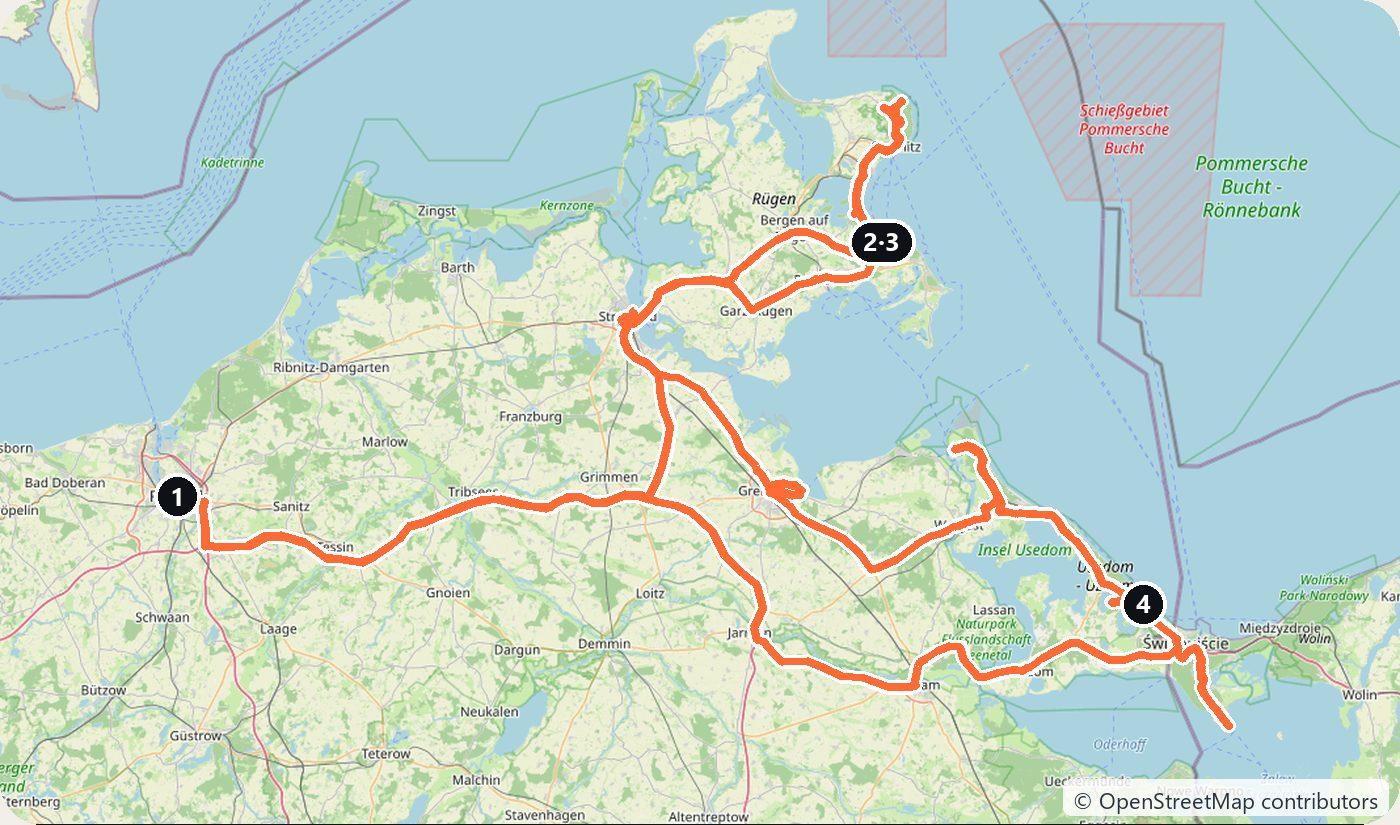
Rügen and Usedom are Germany’s two biggest islands, both on the Baltic coast of Mecklenburg-Vorpommern. This loop starts in Rostock, crosses to Rügen over the bridge at Stralsund and drives up to the white chalk cliffs of Jasmund and the lighthouses of Cape Arkona. Then it goes back to the mainland through Greifswald, over to Usedom and its old imperial spa towns, and home to Rostock. It makes about 608 km in four days.
Germany charges no motorway tolls and no vignette for cars, so the only costs on the road are fuel and parking. Both islands are joined to the mainland by road bridges, and no ferry is needed.
Day 1 — Rostock to Stralsund, Putbus and Binz (156 km)
Pick up the car in Rostock and drive east to Stralsund, an old Hanseatic port of red-brick churches and gabled merchants’ houses. Together with Wismar, its old town has been a UNESCO World Heritage Site since 2002. By the harbour, the Ozeaneum shows the life of the Baltic and the North Sea.
Cross to Rügen on the Rügen Bridge, opened in 2007 and 2,831 m long, and drive to Putbus. Prince Wilhelm Malte I laid out this little town in 1810, and its white classical houses stand around a round square, the Circus. Putbus is also the start of the Rasender Roland, a narrow-gauge steam train that runs all year to Göhren through Binz and Sellin. End the day in Binz, Rügen’s largest seaside resort, with white villas along a long promenade and a pier. Sleep in Binz.
Day 2 — Prora, the Jasmund chalk cliffs and Cape Arkona (100 km)
Just north of Binz stands Prora, a concrete holiday camp built by the Nazi organisation Strength through Joy between 1936 and 1939. Its blocks run for about 4.5 km behind the beach; it was never used for its purpose, and a documentation centre now tells its story.
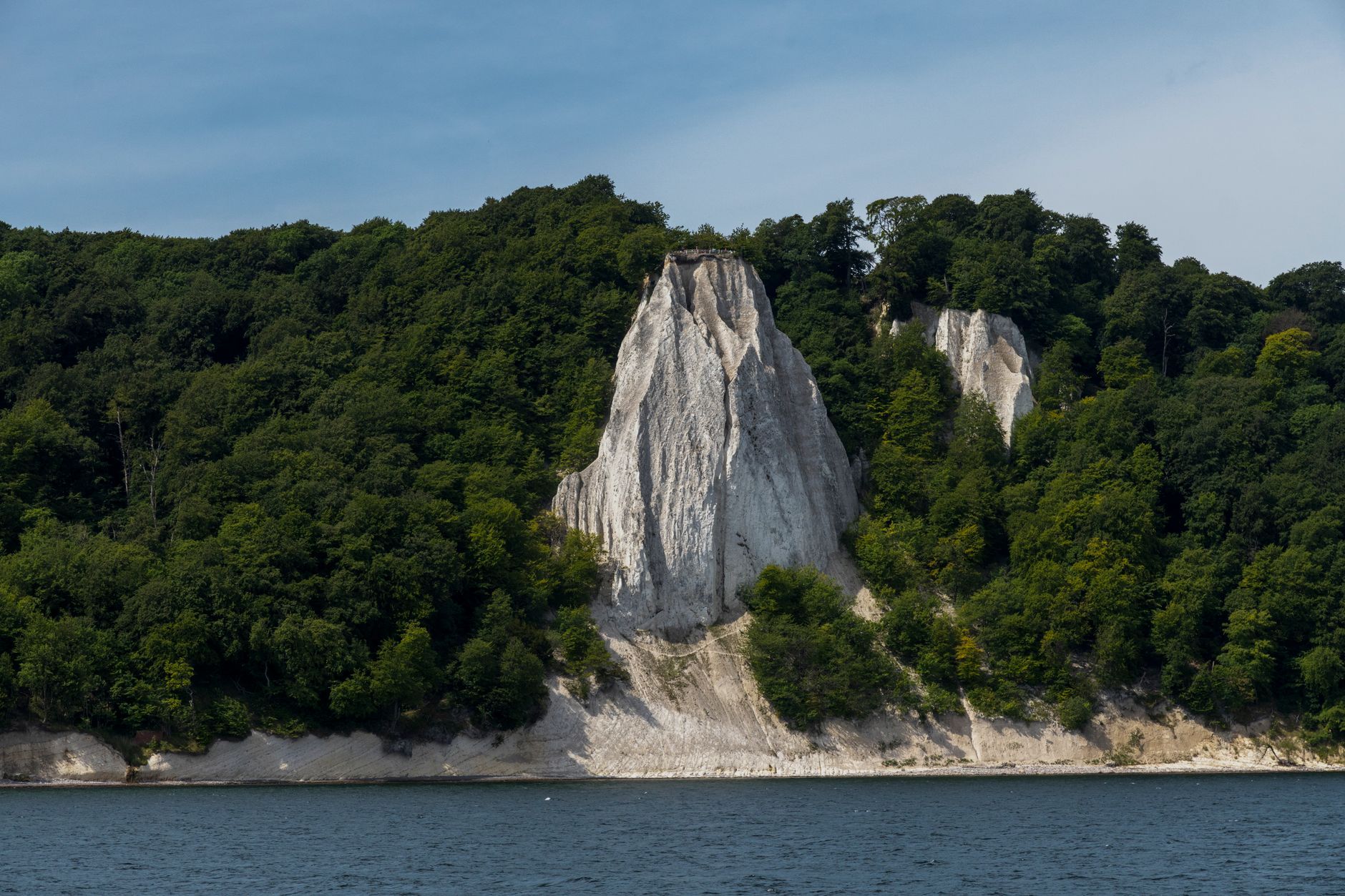
Drive on to Jasmund National Park. Its old beech forests have been part of a UNESCO World Heritage Site since 2011. Cars cannot drive up to the cliffs: park at the large car park in Hagen near Lohme and take the shuttle bus, or walk about 3 km through the forest, to the Königsstuhl, the highest chalk cliff, 118 m above the sea. Since 2023 a level Skywalk has led out over the edge.
In the afternoon, drive north to Cape Arkona, the tip of Rügen. Leave the car at the car park in Putgarten and walk about 2 km to the cape, or take the little road train. Two lighthouses stand side by side: the square brick tower designed by Karl Friedrich Schinkel and finished in 1827, and the taller round one next to it. Drive back to Binz for the night.
Day 3 — Greifswald, Wolgast and Peenemünde to Heringsdorf (171 km)
Leave Rügen and drive to Greifswald, the town where the painter Caspar David Friedrich was born in 1774. At its edge stand the ruins of Eldena Abbey, which he painted again and again, and at Wieck, a wooden drawbridge from 1887 is still raised by hand.
Cross to Usedom on the bridge at Wolgast. It is a lift bridge that opens for ships at set times several times a day, and the road waits while it is up, so check the times before you go. Drive north to Peenemünde, where the German army developed the V2 rocket in the Second World War; the Historical and Technical Museum is in the old power station. Then follow the coast south to Heringsdorf and sleep there.
Day 4 — The imperial spas and Anklam back to Rostock (181 km)
Heringsdorf, Ahlbeck and Bansin are the three Kaiserbäder, the imperial spas, with white villas from the time when Berlin society came here for the sea air. The pier at Heringsdorf is 508 m long, and the one at Ahlbeck, with its little pavilion, dates from 1898. From Ahlbeck the promenade runs on across the border into Poland at Świnoujście.
Leave Usedom by the bridge at Zecherin, which also opens for ships at set times, and drive to Anklam, where the flight pioneer Otto Lilienthal was born in 1848; the Otto Lilienthal Museum tells his story. Then take the motorway back to Rostock.
Costs
Use the cost calculator to price fuel and nights for your dates. There are no tolls on this loop: German motorways are free for cars, and so are the bridges to Rügen and Usedom. Budget for accommodation, fuel for about 608 km, car rental, parking at Hagen and Putgarten, the shuttle bus and Skywalk at the Königsstuhl, and entry to the Ozeaneum and the museum in Peenemünde. Binz and the Kaiserbäder fill up in July and August, so book a room early.
This trip is also in the free Roadcut trip planner: change the number of days and where you sleep each night, pick your vehicle to see the fuel cost, check the weather on the road, and open each day in Google Maps, Apple Maps or Waze.
Where to stay on this route
Night by night, in the towns this itinerary sleeps in.
- Nights 1–2Hotels in Binz →
- Night 3Hotels in Heringsdorf →
The search opens with sample dates a month from today — change them to yours on Booking. Affiliate link — we may earn a commission at no extra cost to you.
The route on video
Get this itinerary by email
The days and the nights in your inbox, with a link back here when you are ready to book.
We use your address only to send this itinerary, unless you tick the box. Privacy
⚡ By electric car on this route
167 charging stations within 1.5 km of the road, 89 of them fast (DC). Most powerful: 400 kW.
Longest stretch without a fast charger tagged: 80 km, from km 389 of the route.
According to OpenStreetMap and operators’ websites. Fast = a DC plug or 50 kW and more; not every station has its power filled in, so there may be more. Power and stations missing from OpenStreetMap also from Bundesnetzagentur.de (CC BY 4.0). See them on the planner map → · EV charging →
🚦 Know before you go
Vignette · Tolls · Bridges & tunnels · Good to know
Vignette. Germany has no vignette for cars, so this loop needs none.
Tolls. No tolls anywhere on this loop. German motorways are free for cars, and so are the bridges to Rügen and Usedom.
Bridges & tunnels. The Rügen Bridge at Stralsund is a high bridge and never closes for ships. The two road bridges to Usedom, at Wolgast and at Zecherin, are lift bridges: several times a day, at set times, they open for boats and the road is closed for up to half an hour, so check the opening times before you cross.
Good to know. Cars cannot drive up to the Königsstuhl cliff or to Cape Arkona: park at the paid car parks in Hagen near Lohme and in Putgarten, then walk or take the shuttle. Binz and the Kaiserbäder on Usedom fill up in July and August, so book a room early.
Estimate your exact costs in the cost calculator. Prices are approximate — check official sites before you travel. Some links are affiliate links.
Plan this trip
Where to sleep
Hotels & B&Bs →Holiday homes & apartments →Campsites (bookable) →Campervan & overnight spots →Tours & tickets
Find things to do →Affiliate link — we may earn a commission at no extra cost to you.
Drive on from here
- Rostock to the Austrian Alps: Kammersberg Road Trip (7 Days)2450 km · 7 days · +105 km to the start
- Småland and Öland from Malmö: Glass, Castles and Lighthouses in 5 Days945 km · 5 days · +107 km to the start
- Bornholm Road Trip from Copenhagen: Castle Ruins, Round Churches and Smokehouses in 3 Days306 km · 3 days · +124 km to the start
More roads nearby
- Bohuslän Coast Road Trip from Gothenburg: Marstrand, Smögen, Fjällbacka and the Tanum Rock Carvings in 3 Days522 km · 3 days
- Krkonoše, Adršpach and Český ráj Road Trip from Prague: Rock Towns, Castles and the Cable Car to Sněžka in 3 Days494 km · 3 days
- Masurian Lakes Road Trip from Gdańsk: the Elbląg Canal, Wolf's Lair, Giżycko and Mikołajki in 4 Days685 km · 4 days
New road trips in your inbox
One email when we publish a new European route — the full guide, map and real costs. No spam, unsubscribe anytime.