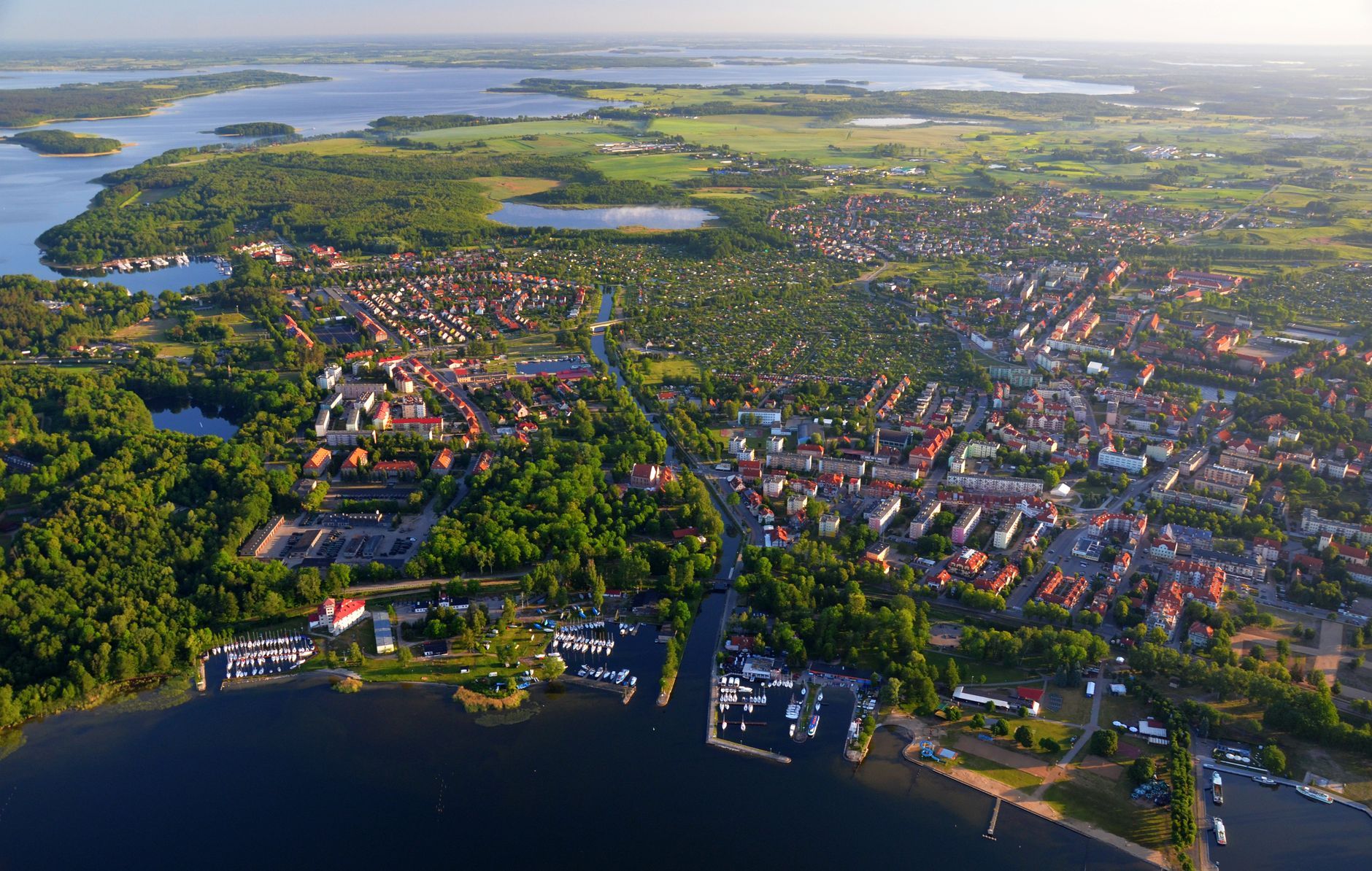
Masurian Lakes Road Trip from Gdańsk: the Elbląg Canal, Wolf's Lair, Giżycko and Mikołajki in 4 Days
A 685 km loop from Gdańsk Airport through Warmia and the Great Masurian Lakes in four days — the boats-on-rails of the Elbląg Canal at Buczyniec, Olsztyn, Reszel castle, the basilica of Święta Lipka, the Wolf's Lair, Boyen fortress and the swing bridge in Giżycko, Mikołajki on Lake Śniardwy and the Krutynia river.
Rough estimate — fuel + nights at typical rates. Get an exact figure in the calculator.
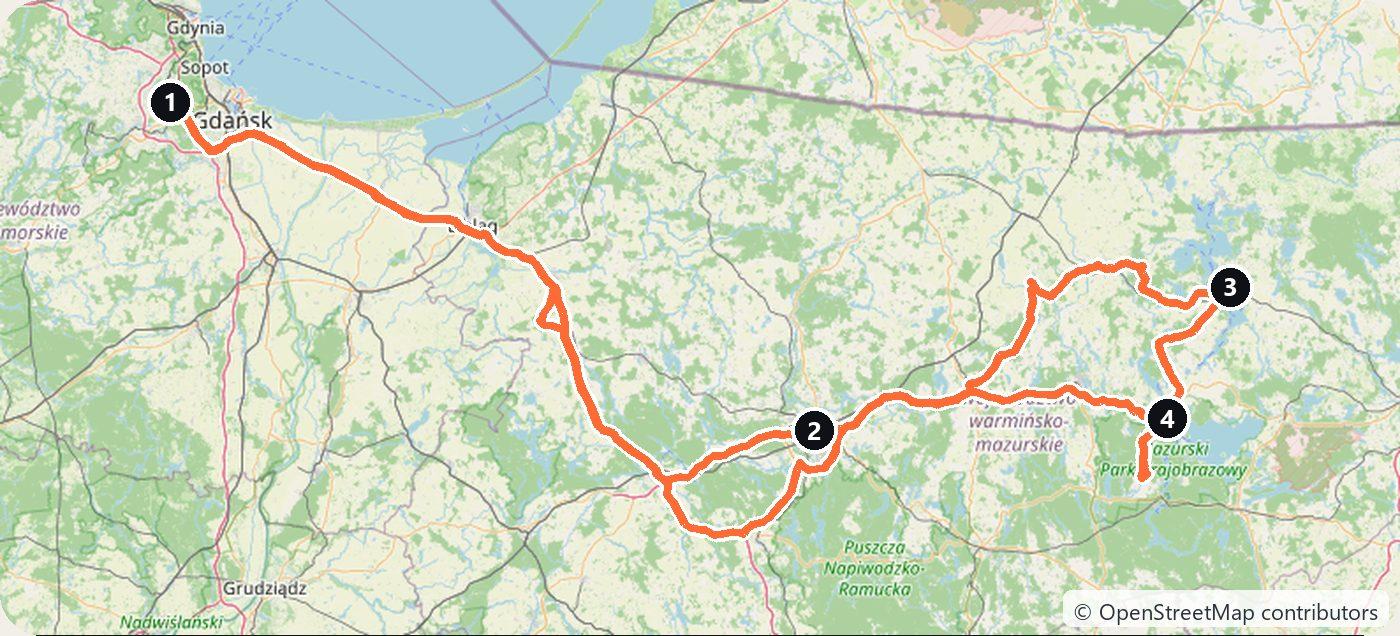
Masuria (Mazury) is the lake country of north-east Poland: the Masurian Lake District has about 2,700 lakes larger than one hectare. This loop starts at Gdańsk Airport, where you pick up the car, and first runs south-east to the Elbląg Canal, where boats cross dry land on rails. Then it crosses Warmia, with Olsztyn, the castle of Reszel and the basilica of Święta Lipka, to the Great Masurian Lakes: the Wolf’s Lair, Giżycko, Mikołajki and the Krutynia river. It makes about 685 km in four days.
We start in Gdańsk rather than Warsaw because it is shorter: the same loop from Warsaw Chopin Airport makes 822 km, with 350 km on the first day. If you live in Warsaw, drive the S7 and S51 to Olsztyn (about 230 km) and join on day 2. The roads are free: no tolls and no vignette.
Day 1 — Gdańsk Airport and the Elbląg Canal at Buczyniec to Olsztyn (189 km)
Pick up the car at Gdańsk Airport and take the S7 south-east past Elbląg to Buczyniec. The Elbląg Canal links Elbląg with the lakes at Ostróda, and on one stretch of about 9 km the land rises 99.5 m. Instead of a staircase of locks, the engineer Georg Jacob Steenke built inclined planes: boats sail onto a carriage, a steel rope pulls the carriage up the grassy slope on rails, and a water wheel in the engine house drives the rope. Four planes, Buczyniec among them, were working by about 1860–1861; the fifth, Całuny, followed in 1883.
In 2026 the planes worked from 25 April to 4 October. Buczyniec closed on 7 October 2026 and stays closed until 23 April 2027, so in late autumn and winter you see the slope and the rails, but no boat goes over them. In season, Żegluga Ostródzko-Elbląska runs boat trips from Buczyniec over the planes.
Drive on to Olsztyn, the capital of the region, and walk through the High Gate into the old town. The castle of the Warmian chapter was built in 1346–1353, and Nicolaus Copernicus ran the chapter’s estates from it in 1516–1521. The museum in the castle closed on 14 September 2026 for about three years of rebuilding, so you see it only from outside. Sleep in Olsztyn.
Day 2 — Reszel, Święta Lipka and the Wolf’s Lair to Giżycko (127 km)
Drive north-east to Reszel. Its brick castle was built for the bishops of Warmia from 1350 to 1401, and today it is a hotel with a gallery. A ticket covers the courtyard, the walls and the tower. In 1811 Barbara Zdunk, accused of setting fire to the town by witchcraft, was burned at the stake here, often called the last such execution in Europe. From 1 November to the end of February the castle is open 9:00–19:00.
Six kilometres east lies Święta Lipka, a Baroque pilgrimage church looked after by the Jesuits. It was consecrated in 1693, and its organ has carved figures that move while it plays. From November to March the organ presentations run on Sundays at 10:00, 12:00 and 15:00, and on other days only by arrangement; there are none on 1–2 November.
Continue past Kętrzyn to Gierłoż and the Wolf’s Lair (Wilczy Szaniec), Hitler’s main headquarters from 1941 to 1944. Begun in autumn 1940, the complex grew to about 250 ha with some 200 structures. Hitler arrived on 24 June 1941 and spent more than 800 days here. On 20 July 1944 Claus von Stauffenberg set off a bomb here, but Hitler survived. The bunkers were blown up on the night of 24–25 January 1945. Today you walk among the ruins of the bunkers in the forest. An audio guide, also in English and German, is handed out at the car park. The site is open all year, from October to February 8:00–16:00. Then drive east to Giżycko. Sleep in Giżycko.
Day 3 — Boyen fortress and the Krutynia to Mikołajki (88 km)
Start at Boyen fortress, built by Prussia to block the strait between Lake Kisajno and Lake Niegocin. Its foundation stone was laid on 4 September 1844, and it is named after the Prussian minister of war Hermann von Boyen. It stands on a hexagonal plan with six bastions and four gates. In November and December it is open 9:00–16:00; the ticket office closes an hour earlier.
In the town, the swing bridge carries the road over the Łuczański Canal, which links the same two lakes. The bridge dates from the late 19th century, weighs over 100 tonnes, and one person turns it by hand in about five minutes. From 1 April to 31 October it swings open for boats several times a day, and the road waits; from November to March it stays closed to boats.
Drive south to Mikołajki, one of the most popular resorts on Lake Śniardwy. At 113.4 km² Śniardwy is the largest lake in Poland. In the afternoon drive to Krutyń on the Krutynia, a river that winds through the Pisz Forest (Puszcza Piska) and the Masurian Landscape Park. Its canoe trail is often called one of the most beautiful in Europe, and kayaks can be rented in Krutyń; outside summer, check with the rental firms before you count on a boat. Drive back to Mikołajki for the night.
Day 4 — Mikołajki to Gdańsk (281 km)
The way back is a long drive on fast roads: west on the S16 past Olsztyn, then north on the S51 and S7 to Gdańsk. If you live in Warsaw, drive straight home from Mikołajki instead: about 257 km, by the S61 and S8.
Costs
Use the cost calculator to price fuel and nights for your dates. Poland has no vignette for cars, and this loop has no tolls: the S7, S51 and S16 expressways are free. Cars pay only on the concession motorway sections, such as the A1 Gdańsk–Toruń, which this route does not use, and the e-TOLL system is needed only for vehicles over 3.5 t. Budget for accommodation, fuel for about 685 km, car rental, and tickets for the Wolf’s Lair (from 1 January 2026: 25 zł from November to March, 30 zł from April to October, plus 15 zł to park a car and 10 zł for an audio guide), Boyen fortress, Reszel castle and, in season, a boat on the Elbląg Canal. Poland has no law requiring winter tyres for cars; the rule is a tread of at least 1.6 mm. Even so, winter tyres are the sensible choice from November.
This trip is also in the free Roadcut trip planner: change the number of days and where you sleep each night, pick your vehicle to see the fuel cost, check the weather on the road, and open each day in Google Maps, Apple Maps or Waze.
Where to stay on this route
Night by night, in the towns this itinerary sleeps in.
- Night 1Hotels in Olsztyn →
- Night 2Hotels in Giżycko →
- Night 3Hotels in Mikołajki →
The search opens with sample dates a month from today — change them to yours on Booking. Affiliate link — we may earn a commission at no extra cost to you.
Get this itinerary by email
The days and the nights in your inbox, with a link back here when you are ready to book.
We use your address only to send this itinerary, unless you tick the box. Privacy
⚡ By electric car on this route
42 charging stations within 1.5 km of the road.
For most of them OpenStreetMap does not record the power, so we cannot say where the fast chargers are — check your charging app before you set off.
According to OpenStreetMap and operators’ websites. Fast = a DC plug or 50 kW and more; not every station has its power filled in, so there may be more. See them on the planner map → · EV charging →
🚦 Know before you go
Vignette · Tolls · Bridges & tunnels · Good to know
Vignette. Poland has no vignette for cars, so this loop needs none.
Tolls. No tolls on this loop: the S7, S51 and S16 expressways are free for cars. In Poland cars pay only on the concession motorway sections, such as the A1 Gdańsk–Toruń, which this route does not use. The e-TOLL system is compulsory only for vehicles over 3.5 t, so a car needs no e-TOLL account here.
Bridges & tunnels. The swing bridge over the Łuczański Canal in Giżycko is free. From 1 April to 31 October it swings open for boats several times a day and the road waits; from November to March it stays closed to boats, so cars cross without stopping.
Good to know. The inclined planes of the Elbląg Canal work only in the boating season: in 2026 from 25 April to 4 October, and Buczyniec is closed from 7 October 2026 to 23 April 2027. The castle museum in Olsztyn closed on 14 September 2026 for about three years of rebuilding. At Święta Lipka the organ presentations run from November to March only on Sundays (10:00, 12:00, 15:00), and not on 1–2 November. Poland has no law requiring winter tyres, but they are the sensible choice from November.
Estimate your exact costs in the cost calculator. Prices are approximate — check official sites before you travel. Some links are affiliate links.
Plan this trip
Where to sleep
Hotels & B&Bs →Holiday homes & apartments →Campsites (bookable) →Campervan & overnight spots →Tours & tickets
Find things to do →Affiliate link — we may earn a commission at no extra cost to you.
More roads nearby
- Bieszczady Road Trip from Rzeszów: Łańcut, Sanok, the Połoniny and the Great Bieszczady Loop in 3 Days435 km · 3 days
- Krkonoše, Adršpach and Český ráj Road Trip from Prague: Rock Towns, Castles and the Cable Car to Sněžka in 3 Days494 km · 3 days
- Bornholm Road Trip from Copenhagen: Castle Ruins, Round Churches and Smokehouses in 3 Days306 km · 3 days
New road trips in your inbox
One email when we publish a new European route — the full guide, map and real costs. No spam, unsubscribe anytime.