Seville to Gibraltar Road Trip Along the Costa de la Luz (4 Days)
A 343 km one-way drive from Seville to Gibraltar in four days: sherry towns Jerez and Sanlúcar, old Cádiz, Cabo de Trafalgar and Vejer, the Roman town of Baelo Claudia, Tarifa on the Strait, and the open border into Gibraltar since July 2026.
Rough estimate — fuel + nights at typical rates. Get an exact figure in the calculator.
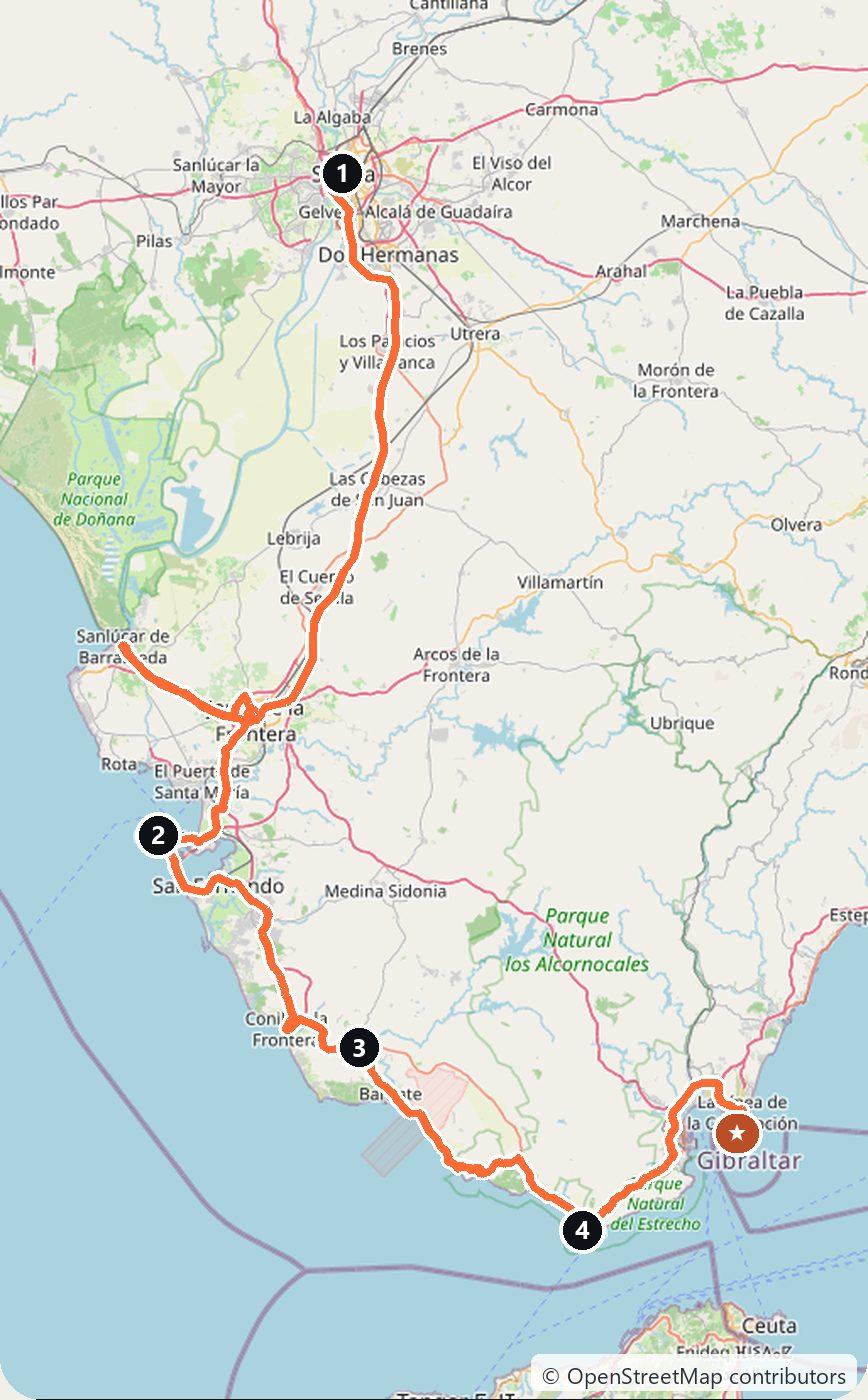
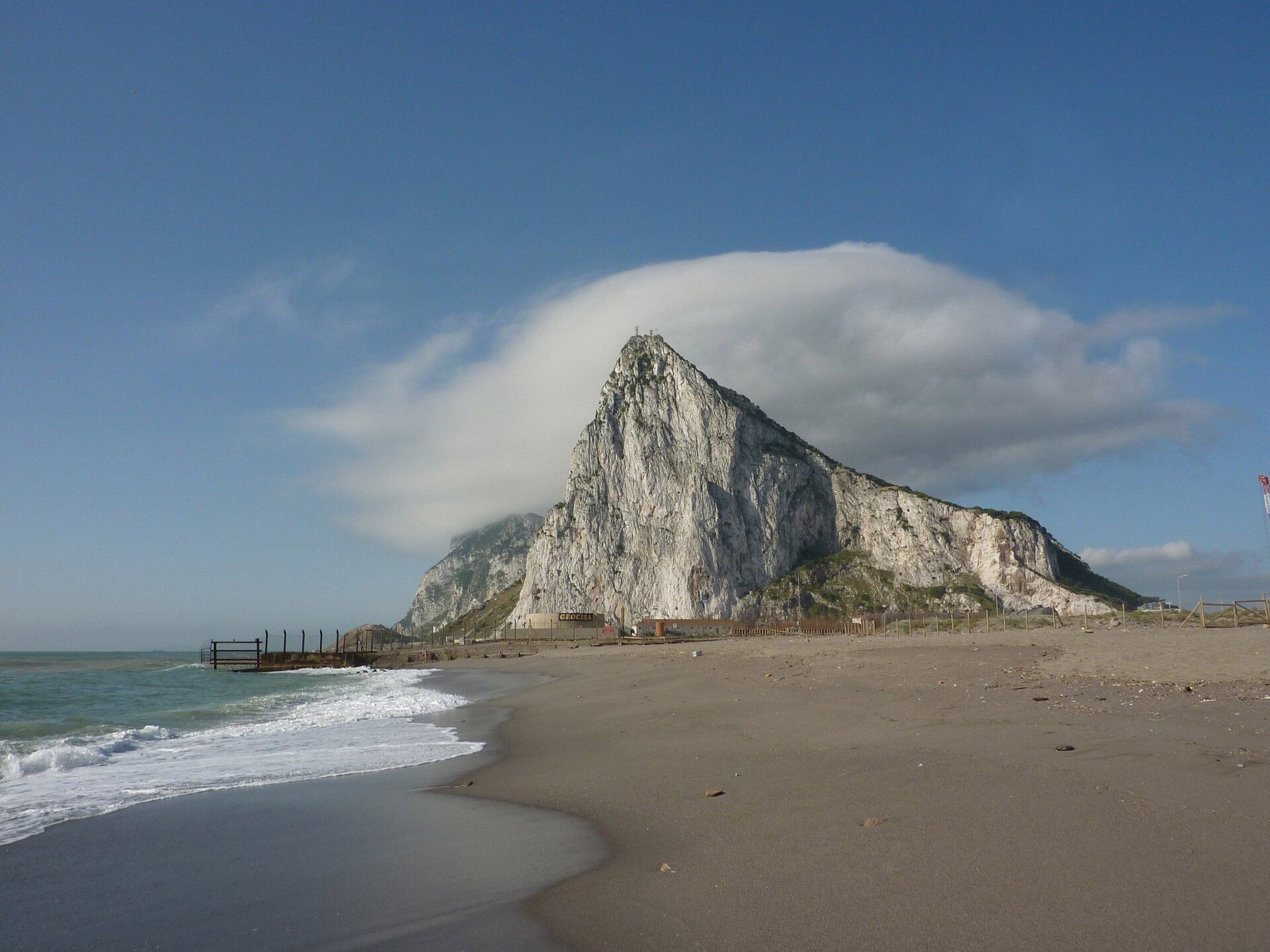
The Costa de la Luz is Andalusia’s Atlantic coast. This one-way drive starts in Seville, drops south through the sherry towns to Cádiz, follows the coast past Cabo de Trafalgar and the Roman ruins of Baelo Claudia to Tarifa, and ends under the Rock of Gibraltar. It takes four days and about 343 km. The driving days are short, and the mild winters make it a good trip outside summer too.
You drive on the right in Spain and in Gibraltar. Spain has no vignette, and the AP-4 motorway from Seville to Cádiz has been toll-free since its concession ended on 1 January 2020. Two things are in flux and worth checking before you go. Cádiz brought in a low-emission zone in May 2026. And the land border into Gibraltar has had no routine checks since 15 July 2026, under a UK–EU treaty that is still being ratified.
Day 1 — Seville to Cádiz via Jerez (167 km)
Pick up the car in Seville and take the AP-4 south. After about 95 km you reach Jerez de la Frontera, the centre of sherry country and its bodegas. Jerez is also home to the Royal Andalusian School of Equestrian Art. Its show, “How the Andalusian Horses Dance”, starts at 12:00 and lasts about an hour and a half with a break. Check the show calendar and book on realescuela.org.
Continue to Sanlúcar de Barrameda, at the mouth of the Guadalquivir. The wine called Manzanilla-Sanlúcar de Barrameda can only be aged in the town’s own cellars. Across the river lies Doñana National Park. Boats run into the park from the Fábrica de Hielo visitor centre on the Bajo de Guía beach. The trip lasts about two and a half to three hours, depending on the tides, and includes a guided walk on the far bank. The operator, Visitas Doñana, advises booking as early as you can, above all for weekends and holidays. You will not have time for both the horse show and the boat on the same day, so pick one.
Drive south to Cádiz and sleep there.
Cádiz and its low-emission zone. The zone covers the old town inside the ring road, plus a stretch of the seafront promenade, and 33 cameras watch it. In 2026, Spanish cars from outside the city may enter only with a DGT Zero, Eco or C label; Spanish cars with a B label or none are kept out, and from 2027 C cars will be too. A foreign-registered car cannot get a DGT label and, according to the DGT, does not need one: the city judges it by its Euro standard, so check cadiz.es before you drive in. Driving to a public car park is not fined. Fines are €200, but the council said it would not issue any for the first six months, and reports differ on whether that ends in November or December 2026. The simplest plan is to park outside the old town and walk in.
Day 2 — Cádiz to Vejer de la Frontera (71 km)
Spend the morning on foot in Cádiz. The Cádiz Cathedral opens Monday to Saturday from 10:00 to 20:00 and on Sunday from 13:30 to 20:00, with last entry at 19:00. A general ticket costs €12. A few streets away, the Torre Tavira watchtower has views over the rooftops and a camera obscura, which the tower bills as the first in Spain. It opens daily from 10:00 to 18:00 from October to April, and until 20:00 from May to September. Visits take 45 minutes, entry costs €8, and you must book a time on its website. Then walk west to La Caleta, the old town’s small beach.
Leave Cádiz in the early afternoon and drive about 45 km to Conil de la Frontera, a white town on the coast. About 13 km south is Cabo de Trafalgar. Off this cape, on 21 October 1805, Nelson’s fleet defeated the combined French and Spanish fleets. Its 34 m lighthouse was first lit on 15 July 1862.
End the day 14 km inland at Vejer de la Frontera, a white town on a hill above the Barbate river, and sleep there.
Day 3 — Vejer de la Frontera to Tarifa (56 km)
Drive down to Zahara de los Atunes, a village on a long beach, then follow the N-340 towards Tarifa and turn off for Bolonia.
At the end of the bay stands Baelo Claudia, a Roman town on the edge of the Strait. It was abandoned by the 6th century. From 21 September to 20 March it opens Tuesday to Saturday from 9:00 to 18:00, and on Sundays and holidays from 9:00 to 15:00. Mondays are closed unless they come before a holiday. From 21 March to 20 June it stays open until 21:00 from Tuesday to Saturday, and from 21 June to 20 September it closes at 15:00. It is also closed on 1 and 6 January, 1 May, and 24, 25 and 31 December.
Beside the ruins is the Duna de Bolonia, an active dune about 30 m high. The Junta de Andalucía closed the trail and viewpoint on the dune on 8 May 2026 for improvement works. We found no reopening date, so obey the signs. Baelo Claudia kept its normal hours.
Continue to Tarifa and sleep there. The Isla de las Palomas, joined to the town by a causeway since 1808, is the southernmost point of continental Europe. At its narrowest the Strait is about 14 km wide. The island cannot be explored freely; visits run as organised guided walks.
Day 4 — Tarifa to Gibraltar (49 km)
About 7 km out of Tarifa on the N-340 is the Mirador del Estrecho, a viewpoint about 300 m above the sea. On a clear day you can see Ceuta, Jebel Musa and the port of Tanger-Med across the water. Then drive round the Bay of Algeciras to La Línea de la Concepción, the Spanish town at the border.
Crossing into Gibraltar. Under the UK–EU agreement, signed on 14 July 2026 and applied provisionally since 15 July, the land frontier has no routine immigration or customs checks. Passport checks for Gibraltar and the Schengen area now happen at Gibraltar’s airport and port. The treaty is not yet fully ratified: the European Parliament’s vote was set for 14 December 2026. Check gibraltar.gov.gi and visitgibraltar.gi before you cross.
You can drive in. There is no entry fee, and the speed limit is 50 km/h unless signs say otherwise. Cars reach the town through the Kingsway tunnel under the airport runway, opened in 2023. First check your rental contract. Some Spanish rental firms allow Gibraltar only with written permission and an extra fee. Streets are narrow and parking is pay-and-display, so the easiest option is to leave the car in La Línea and walk across.
The 426 m Rock of Gibraltar is mostly the Upper Rock Nature Reserve, home to about 300 Barbary macaques. Only locally registered vehicles may drive into the reserve, so you cannot take your hire car up. Walk up, or join a Rock tour or a taxi. An adult ticket costs £30 (children 5–11 £22) and covers the reserve’s trails and attractions, including St Michael’s Cave and the Skywalk. From 1 October to 30 April it opens from 09:00 to 18:15, with last entry at 17:45. The cable car is closed for a full refurbishment and is expected to reopen in 2027.
Finish at Europa Point, the southern tip of Gibraltar, with views across to the Rif mountains of Morocco. Gibraltar’s currency is the Gibraltar pound, at par with sterling. Euros and cards are widely accepted, though a bureau de change usually gives a better rate. Sleep in Gibraltar or La Línea.
Costs
Use the cost calculator to price fuel and nights for your dates. There is no vignette and no motorway toll on this route. Budget for accommodation, fuel for about 343 km, a one-way rental fee, parking in Cádiz and La Línea, and tickets: the Cádiz Cathedral (€12), the Torre Tavira (€8) and the Upper Rock Nature Reserve (£30), plus a bodega tour, the horse show or the Doñana boat. To drive into Gibraltar, get the rental company’s permission, fee and insurance cover in writing.
This trip is also in the free Roadcut trip planner: change the number of days and where you sleep each night, pick your vehicle to see the fuel cost, check the weather on the road, and open each day in Google Maps, Apple Maps or Waze.
Where to stay on this route
Night by night, in the towns this itinerary sleeps in.
- Night 1Hotels in Cádiz →
- Night 2Hotels in Vejer de la Frontera →
- Night 3Hotels in Tarifa →
- Night 4Hotels in Gibraltar →Hotels in La Línea de la Concepción →
The search opens with sample dates a month from today — change them to yours on Booking. Affiliate link — we may earn a commission at no extra cost to you.
Get this itinerary by email
The days and the nights in your inbox, with a link back here when you are ready to book.
We use your address only to send this itinerary, unless you tick the box. Privacy
⚡ By electric car on this route
132 charging stations within 1.5 km of the road, 71 of them fast (DC). Most powerful: 360 kW.
Longest stretch without a fast charger tagged: 69 km, from km 229 of the route.
According to OpenStreetMap and operators’ websites. Fast = a DC plug or 50 kW and more; not every station has its power filled in, so there may be more. Power and stations missing from OpenStreetMap also from DGT / MITERD — nap.dgt.es (CC BY). See them on the planner map → · EV charging →
🚦 Know before you go
Tolls · Good to know
Tolls. No tolls on this route. The AP-4 from Seville towards Jerez and Cádiz has been toll-free since its concession ended on 1 January 2020, and the N-340 along the coast to Tarifa and Algeciras is a free road. Gibraltar charges no entry fee.
Good to know. Since 15 July 2026 the land border into Gibraltar has had no routine immigration or customs checks under the UK–EU agreement, which is applied provisionally until it is ratified (the European Parliament vote was set for 14 December 2026); passport checks now happen at Gibraltar's airport and port. Driving in is allowed and costs nothing, and traffic keeps right, but some Spanish rental firms only permit Gibraltar with written permission and a fee, so get it on the contract. Parking in Gibraltar is pay-and-display and the streets are narrow, so the easy option is to park in La Línea and walk across. Hire cars cannot drive up the Upper Rock (only locally registered vehicles may enter the nature reserve), and the cable car is closed for refurbishment until 2027. Cádiz's low-emission zone (old town and part of the seafront, since May 2026) admits Spanish cars from outside the city only with a DGT Zero, Eco or C label (a foreign car cannot get that label and, says the DGT, does not need it; the city decides by Euro standard, so check cadiz.es first); €200 camera fines were due to start after a six-month grace period. Check gibraltar.gov.gi and visitgibraltar.gi before you cross.
Estimate your exact costs in the cost calculator. Prices are approximate — check official sites before you travel. Some links are affiliate links.
Plan this trip
Where to sleep
Hotels & B&Bs →Holiday homes & apartments →Campsites (bookable) →Campervan & overnight spots →Tours & tickets
Find things to do →Affiliate link — we may earn a commission at no extra cost to you.
Drive on from here
New road trips in your inbox
One email when we publish a new European route — the full guide, map and real costs. No spam, unsubscribe anytime.