Harz Mountains Road Trip from Hannover: Goslar, the Brocken and Quedlinburg in 3 Days
A 358 km loop through the Harz from Hannover in three days — the old mining town of Goslar and the Rammelsberg, the Oker valley, Torfhaus, the steam train up the Brocken, Wernigerode, the Bode gorge at Thale and the half-timbered town of Quedlinburg.
Rough estimate — fuel + nights at typical rates. Get an exact figure in the calculator.
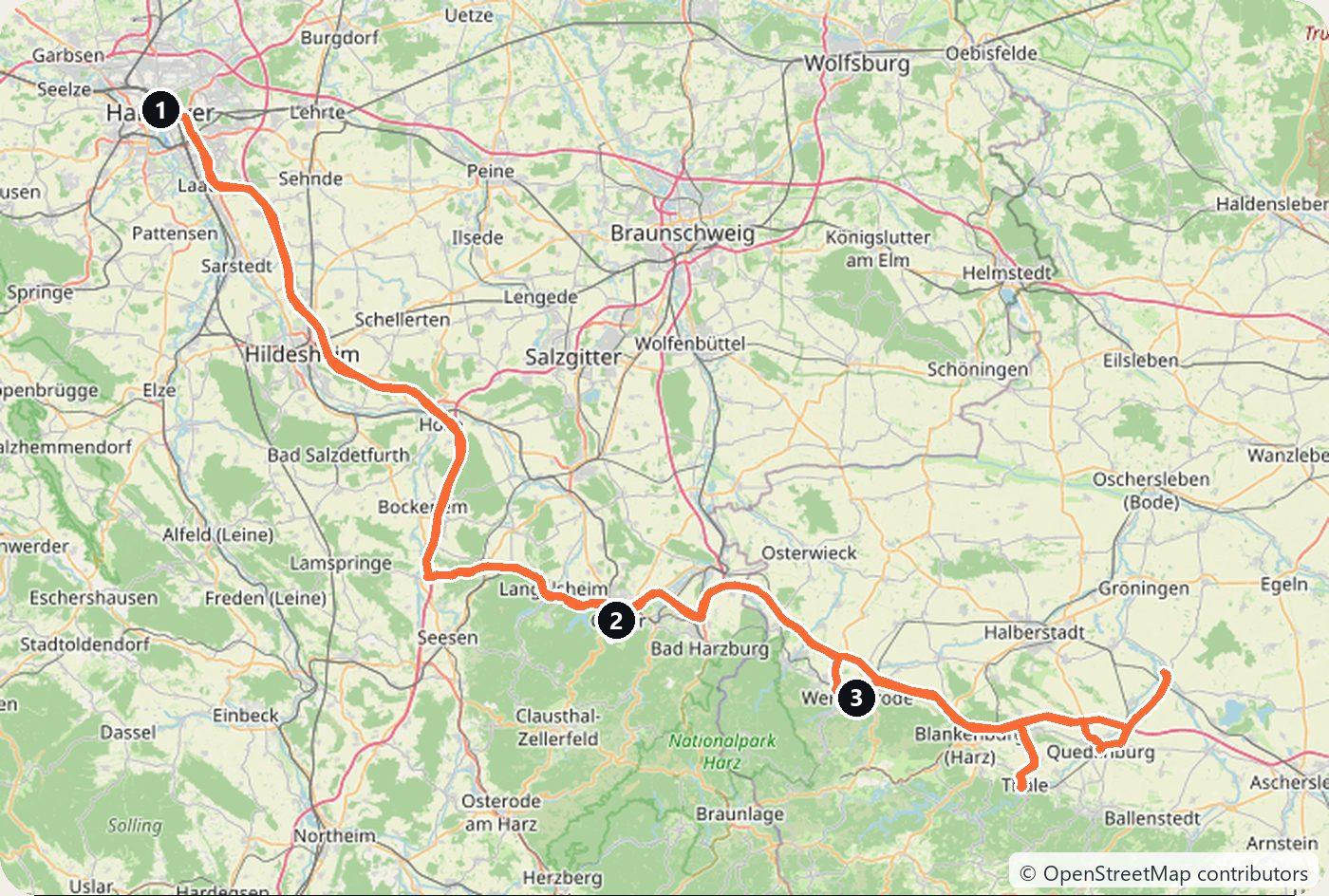
The Harz is a block of forested hills south-east of Hannover, mostly in Lower Saxony and Saxony-Anhalt, and its summit, the Brocken, is the highest point in northern Germany. This loop starts in Hannover, drives to the old mining town of Goslar, up the Oker valley to Torfhaus, and takes the narrow-gauge steam train up the Brocken. Then it goes down to Wernigerode, the gorge of the Bode at Thale and the half-timbered streets of Quedlinburg, and back to Hannover. It makes about 358 km in three days.
Germany charges no motorway tolls and no vignette for cars, so the only costs on the road are fuel and parking. You cannot drive to the top of the Brocken: the road from Schierke to the summit is closed to private cars, so you leave the car in Schierke and go up by train or on foot.
Day 1 — Hannover to Goslar (96 km)
Pick up the car in Hannover and take the motorway south to Goslar, on the northern edge of the Harz. Goslar grew rich on the silver, lead and copper of the Rammelsberg, the mountain just above the town. The mine was worked for more than 1,000 years until it closed in 1988, and together with the old town it has been a UNESCO World Heritage Site since 1992. The site was extended in 2010 to include the Upper Harz Water Management System, the ponds, ditches and tunnels that powered the mines.
At the Rammelsberg, the mine buildings are now a museum, and guided tours take you underground, some of them on the old mine train. The tours are in German. Back in town, walk through an old town of more than 1,500 half-timbered houses to the Kaiserpfalz, the imperial palace where medieval German kings and emperors held court; the building you see today was heavily restored in the 19th century. Sleep in Goslar.
Day 2 — The Oker valley, Torfhaus and the Brocken to Wernigerode (69 km)
Leave Goslar through its eastern district of Oker and take the B498 up the Oker valley, a narrow, wooded valley with rocky cliffs above the river. At Romkerhall, stop for the waterfall: about 64 m high, it is artificial, made in 1863 by diverting a mountain stream over the cliff. Further up, the road runs along the Oker reservoir, held back by a dam finished in 1956, and climbs past Altenau to Torfhaus.
Torfhaus lies at about 800 m, with a wide view across the moor to the Brocken, about 5 km away. The national park visitor centre is here, and the Goethe Way starts here: on 10 December 1777 the poet Goethe walked from Torfhaus to the summit through deep snow.
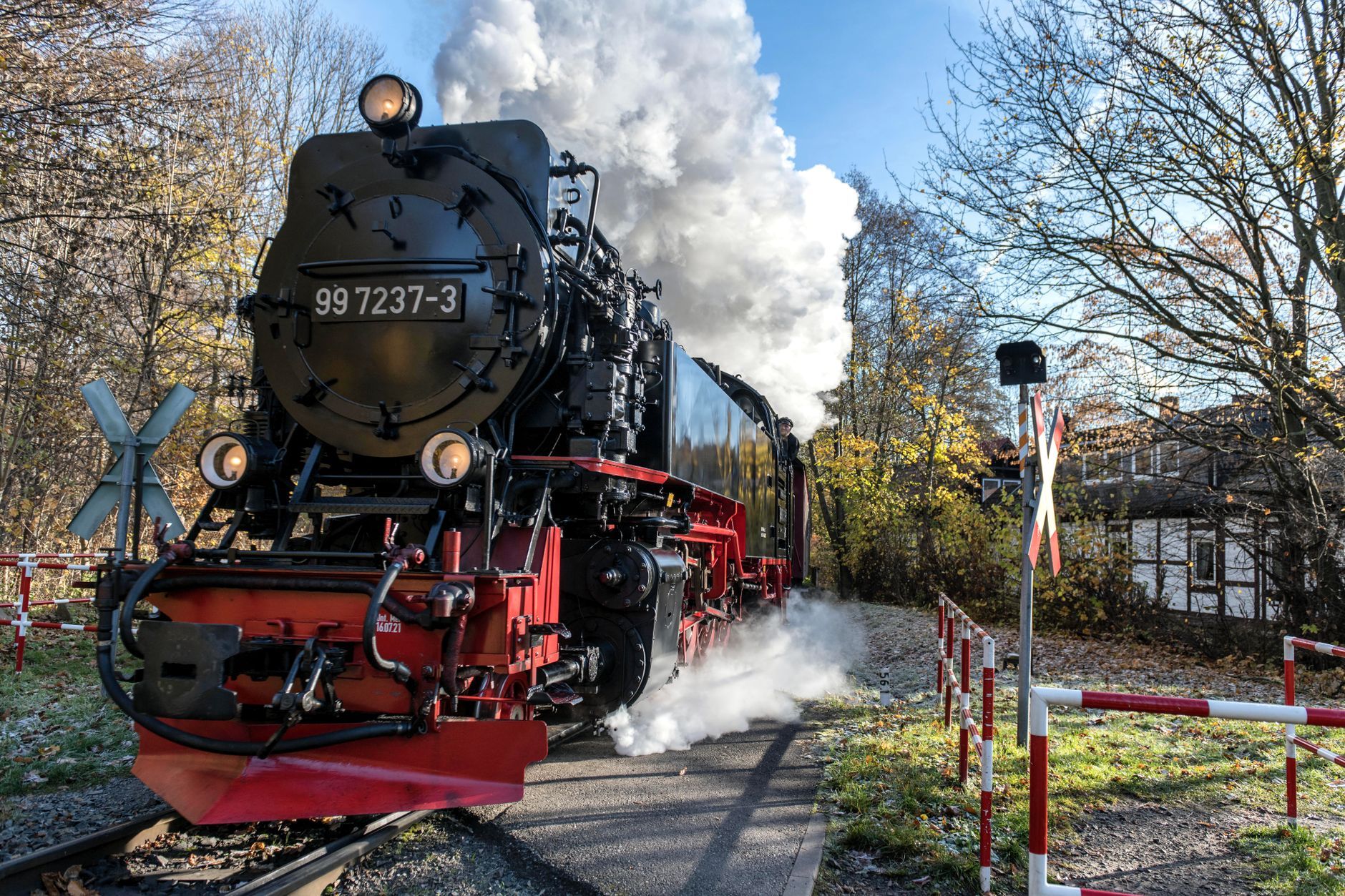
Drive on through Braunlage to Schierke and leave the car in the car park there. The Brocken railway of the Harzer Schmalspurbahnen climbs from Schierke to the summit with steam locomotives; the Brocken station lies at 1,125 m, just below the top at 1,141 m, the highest point in the Harz. During the Cold War the summit was a closed military zone on the border of East Germany, and it opened to the public again only on 3 December 1989, a few weeks after the fall of the Berlin Wall. If you prefer to walk, marked paths lead up from Schierke. Come back down to Schierke, and drive the last stretch to Wernigerode for the night.
Day 3 — Thale and Quedlinburg back to Hannover (193 km)
In the morning, walk the old town of Wernigerode, with its half-timbered town hall on the market square and the castle on the hill above it. Wernigerode Castle was rebuilt between 1862 and 1885 for Count Otto of Stolberg-Wernigerode, in the romantic historic style of its day.
Drive east to Thale, where the river Bode leaves the Harz through a deep granite gorge. A cable car runs from the valley up to the Hexentanzplatz, the “witches’ dancing ground”, and a chairlift on the other side climbs to the Rosstrappe, a rock with a hoof print that legend says was left by a princess’s horse leaping across the gorge. Both close for several weeks in November and December, so check the dates before you go. A path of about 10 km follows the bottom of the gorge from Thale to Treseburg.
Continue to Quedlinburg, a short drive north-east. Its old town, with more than 2,000 half-timbered houses, the castle hill and the Romanesque collegiate church of St Servatius, has been a UNESCO World Heritage Site since 1994. Henry I, the first king of the Ottonian dynasty, was buried on the castle hill in 936. At the end of the Second World War an American soldier stole some of the finest pieces of the church treasure; most of them were returned to the church in 1993. Then take the motorway back to Hannover.
Costs
Use the cost calculator to price fuel and nights for your dates. There are no tolls on this loop: German motorways are free for cars. Budget for accommodation, fuel for about 358 km, car rental, parking in Schierke and the old towns, the Brocken railway ticket, entry to the Rammelsberg museum and the cable car or chairlift in Thale. Tickets for the Brocken train can be booked online a few weeks ahead.
This trip is also in the free Roadcut trip planner: change the number of days and where you sleep each night, pick your vehicle to see the fuel cost, check the weather on the road, and open each day in Google Maps, Apple Maps or Waze.
Where to stay on this route
Night by night, in the towns this itinerary sleeps in.
- Night 1Hotels in Goslar →
- Night 2Hotels in Wernigerode →
Compare the towns to stay in →
The search opens with sample dates a month from today — change them to yours on Booking. Affiliate link — we may earn a commission at no extra cost to you.
The route on video
Get this itinerary by email
The days and the nights in your inbox, with a link back here when you are ready to book.
We use your address only to send this itinerary, unless you tick the box. Privacy
⚡ By electric car on this route
146 charging stations within 1.5 km of the road, 77 of them fast (DC). Most powerful: 400 kW.
Longest stretch without a fast charger tagged: 35 km, from km 252 of the route.
According to OpenStreetMap and operators’ websites. Fast = a DC plug or 50 kW and more; not every station has its power filled in, so there may be more. Power and stations missing from OpenStreetMap also from Bundesnetzagentur.de (CC BY 4.0). See them on the planner map → · EV charging →
🚦 Know before you go
Vignette · Tolls · Good to know
Vignette. Germany has no vignette for cars, so this loop needs none.
Tolls. No tolls anywhere on this loop. German motorways are free for cars.
Good to know. Cars cannot drive up the Brocken: the road from Schierke to the summit is closed to private vehicles, so park in Schierke (paid) and take the Harzer Schmalspurbahnen steam train or walk. Check the HSB timetable before you go, as track work sometimes ends trains short of the summit. The cable car and chairlift in Thale close for several weeks in November and December. Hannover lifted its low-emission zone in 2024, so no sticker is needed to pick up the car there.
Estimate your exact costs in the cost calculator. Prices are approximate — check official sites before you travel. Some links are affiliate links.
Plan this trip
Where to sleep
Hotels & B&Bs →Holiday homes & apartments →Campsites (bookable) →Campervan & overnight spots →Tours & tickets
Find things to do →Affiliate link — we may earn a commission at no extra cost to you.
More roads nearby
- Franconia Christmas Markets Road Trip: 344 km from Nuremberg in 4 Days344 km · 4 days
- Lake Constance Road Trip from Friedrichshafen: Three Countries, the Rhine Falls and Lindau in 3 Days270 km · 3 days
- South Moravia Road Trip from Brno: Caves, Wine Cellars and the Lednice–Valtice Chateaux in 3 Days283 km · 3 days
New road trips in your inbox
One email when we publish a new European route — the full guide, map and real costs. No spam, unsubscribe anytime.