Lake Constance Road Trip from Friedrichshafen: Three Countries, the Rhine Falls and Lindau in 3 Days
A 270 km loop around Lake Constance (Bodensee) from Friedrichshafen in three days, through Germany, Switzerland and Austria — the pile dwellings at Unteruhldingen, Meersburg castle, the car ferry to Konstanz, Mainau, the monastic island of Reichenau, Stein am Rhein, the Rhine Falls, the Pfänder above Bregenz and Lindau island, without motorways.
Rough estimate — fuel + nights at typical rates. Get an exact figure in the calculator.
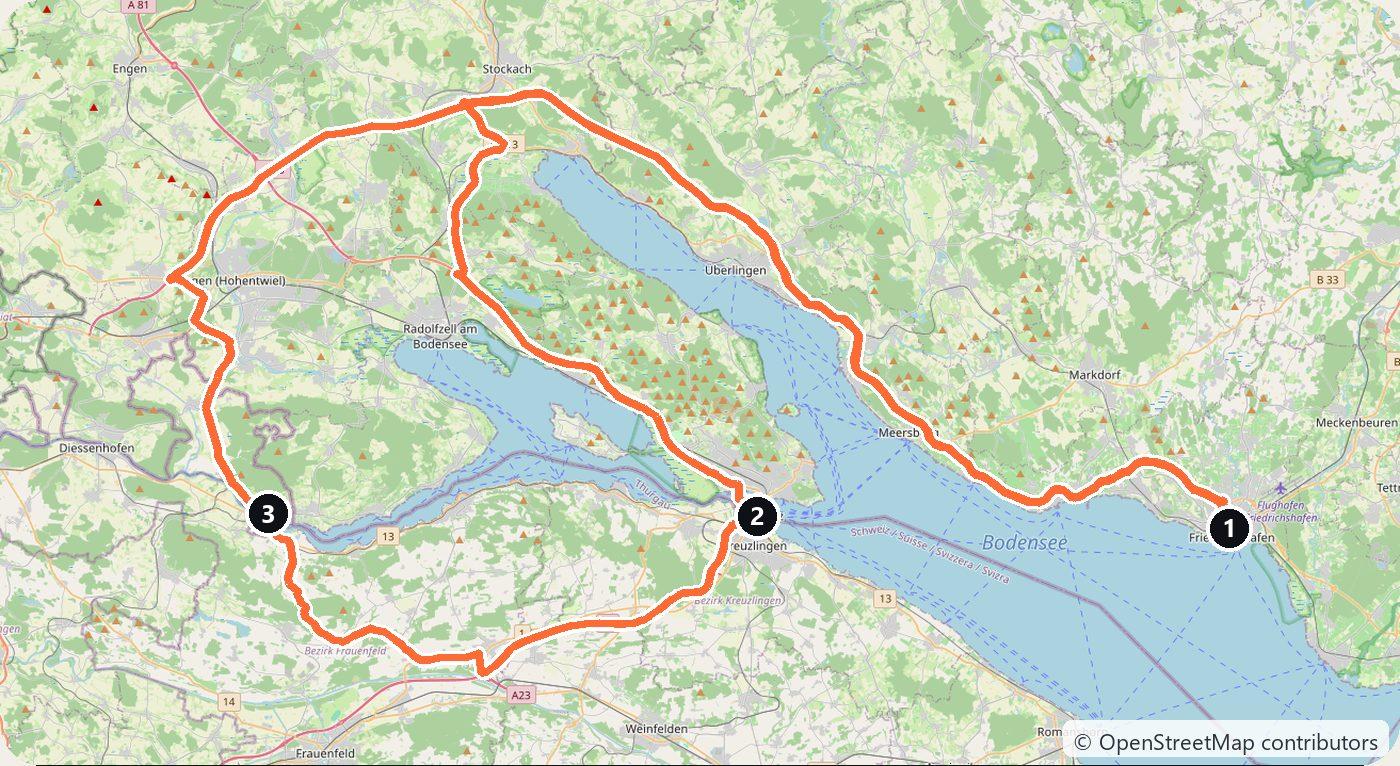
Lake Constance (the Bodensee) sits where Germany, Switzerland and Austria meet, and one loop around it takes you through all three. This route starts in Friedrichshafen on the north shore, where rental companies such as Sixt, Europcar and Enterprise have desks at the airport or in town. You cross the lake on the car ferry from Meersburg to Konstanz, follow the Untersee and the Rhine west to Stein am Rhein and the Rhine Falls, then come back along the Swiss shore to Bregenz and Lindau. It makes about 270 km in three days.
The loop stays on ordinary roads in all three countries, so you need neither the Swiss nor the Austrian vignette, and German roads are free for cars. Our Deutsche Alpenstraße trip starts in Lindau and heads east into the Bavarian Alps; this one stays on the lake. Many sights here keep shorter winter hours or close from November, and the dates are given below.
Day 1 — Friedrichshafen to Konstanz via Meersburg and Mainau (50 km)
Pick up the car in Friedrichshafen and drive west on the B31 to Unteruhldingen. The Pfahlbauten (pile dwellings) museum has 23 reconstructed houses on stilts in the lake, showing life in the Stone and Bronze Ages; its first two houses went up in 1922. The pile dwellings have been part of a UNESCO World Heritage Site since 2011, with 111 sites in six countries. The museum is open daily until 1 November; from 2 November it opens at weekends only, and from December to February only for guided winter tours (Tuesday to Thursday). It opens daily again from late March.
Drive on to Meersburg. The Burg Meersburg, the old castle above the harbour, calls itself the oldest inhabited castle in Germany. It is open every day of the year: in winter, from November to mid-March, from 10:00 to 18:00.
Then take the car ferry from Meersburg to Konstanz-Staad. It runs around the clock, all year, and the crossing takes about 15 minutes. Since 1 January 2026 a car up to 5 m long pays €15.50 one way, driver included.
From Staad it is a short drive to Mainau, the flower island. It is open all year, but the hours shrink: from 19 October to 18 November 2026 day visitors go in from 9:00 to 16:00, and from 19 November to 9 January from 9:00 to 15:30. The butterfly house and the palm house stay open in winter. In the evenings from 19 November 2026 to 9 January 2027, the Christmas Garden lights up the park.
Drive into Konstanz for the night. At the harbour stands the Imperia, a 9 m statue by Peter Lenk put up in 1993 that turns once every four minutes. It mocks the Council of Constance (1414–1418), the church council held in the town.
Day 2 — Reichenau and the Rhine Falls to Stein am Rhein (95 km)
Drive west to Reichenau, the largest island in the lake, reached over a causeway lined with poplars. Saint Pirmin founded its monastery in 724, and the island has been a UNESCO World Heritage Site since 2000. Three churches tell the story: the Minster of St Mary and St Mark in Mittelzell, St Peter and Paul in Niederzell, and St George in Oberzell, whose nave paintings date from around 1000.
Continue through Radolfzell and over the Höri peninsula to Stein am Rhein in Switzerland. The houses around the Rathausplatz are covered in painted façades, and Hohenklingen castle watches from the hill above. The St Georgen monastery museum, founded as a Benedictine monastery in the 11th century, closes for the season after 1 November 2026.
Follow Swiss main road 13 down the Rhine to Schaffhausen and the Rhine Falls at Neuhausen. The river drops about 23 m over a width of about 150 m. The banks are open day and night all year, and the basin by the Schlössli Wörth is free. On the south bank, Schloss Laufen charges a small fee for its viewing platforms. The boats to the rock in the middle of the falls run from about April to mid-October, so in winter you watch from the shore. Drive back to Stein am Rhein for the night.
Day 3 — The Swiss shore, Bregenz and Lindau to Friedrichshafen (125 km)
Take road 13 east along the Untersee through Steckborn to Kreuzlingen, then keep to the Swiss shore of the main lake through Romanshorn, Arbon and Rorschach. The road crosses into Austria at Rheineck and runs on through Hard to Bregenz.
In Bregenz, the Pfänderbahn cable car climbs in about six minutes to the Pfänder (1,064 m), with the whole lake below you. It runs daily from 8:00 to 19:00, every half hour, and the Alpenwildpark at the top, with ibex and marmots, is free. The cable car stops for maintenance from 11 January to 4 March 2027.
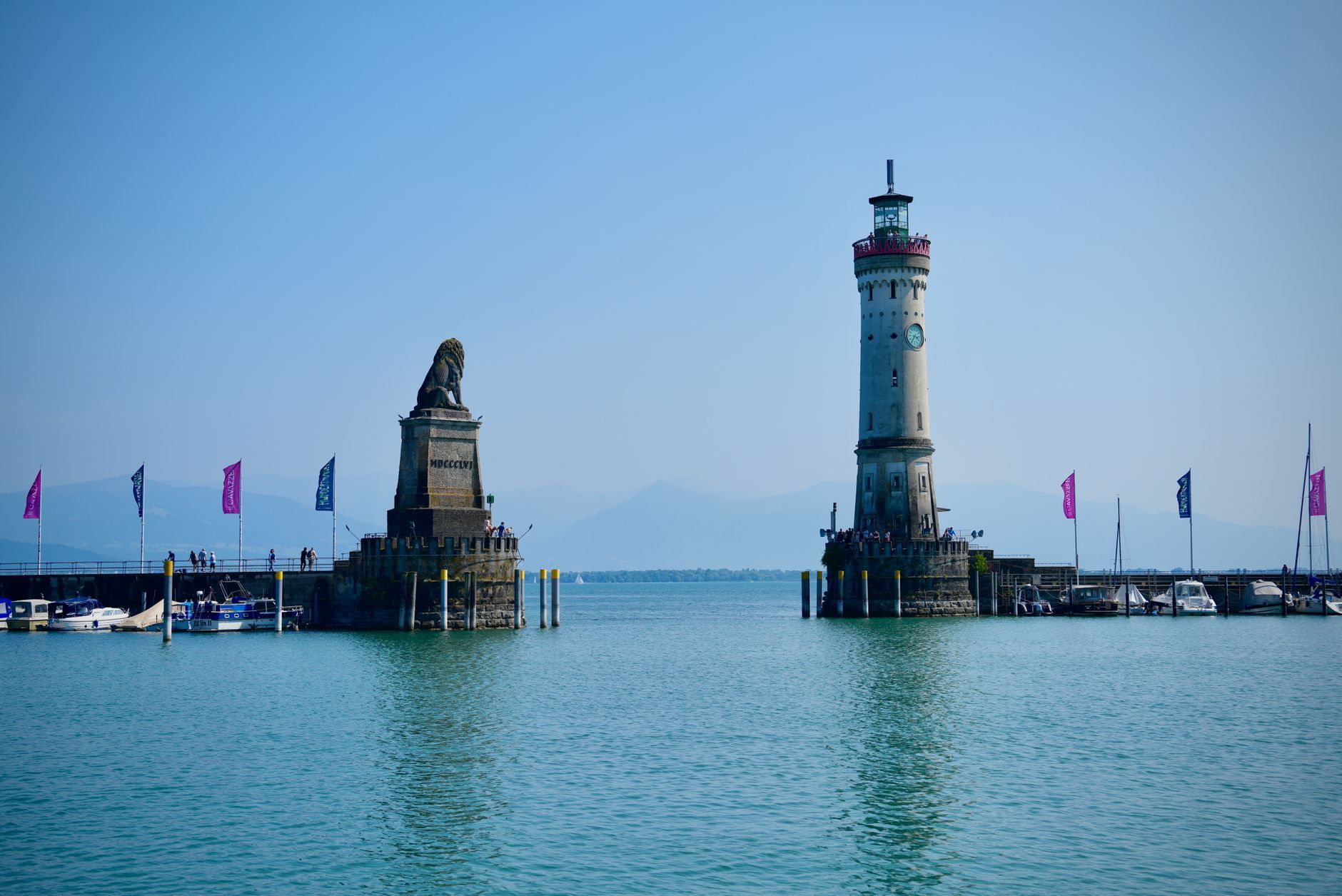
Then drive round the shore to Lindau, an old town on an island at the east end of the lake. At the harbour mouth stand the Bavarian Lion (1856, 6 m high) and the New Lighthouse (36 m, finished in 1856), the southernmost lighthouse in Germany. In the lanes behind, the Old Town Hall was built in 1422 and painted in 1885–1887. Drive back to Friedrichshafen on the B31.
Costs
Use the cost calculator to price fuel and nights for your dates. With this routing there are no tolls and no vignettes: Germany charges nothing for cars, and the loop uses only main roads in Switzerland and Austria. If you take a motorway, Switzerland needs the CHF 40 vignette (valid 1 December 2025 to 31 January 2027; buy the e-vignette at e-vignette.ch), and Austria the 2026 digital vignette, from €9.60 for one day. The Austrian A14 from the German border at Hörbranz to the Hohenems junction is vignette-free for cars. Budget for the ferry (€15.50 one way), parking in Meersburg, Konstanz, Lindau and at the Rhine Falls, and tickets for Mainau, the Pfahlbauten, Burg Meersburg, Schloss Laufen and the Pfänderbahn. Winter tyres: in Austria they are compulsory from 1 November to 15 April whenever the roads are wintry; in Germany they are required in wintry conditions, and only tyres with the Alpine symbol count; Switzerland has no general rule, but you can be fined if your tyres hold up traffic and share the blame in an accident.
This trip is also in the free Roadcut trip planner: change the number of days and where you sleep each night, pick your vehicle to see the fuel cost, check the weather on the road, and open each day in Google Maps, Apple Maps or Waze.
Where to stay on this route
Night by night, in the towns this itinerary sleeps in.
- Night 1Hotels in Konstanz →
- Night 2Hotels in Stein am Rhein →
The search opens with sample dates a month from today — change them to yours on Booking. Affiliate link — we may earn a commission at no extra cost to you.
The route on video
Get this itinerary by email
The days and the nights in your inbox, with a link back here when you are ready to book.
We use your address only to send this itinerary, unless you tick the box. Privacy
⚡ By electric car on this route
119 charging stations within 1.5 km of the road, 38 of them fast (DC). Most powerful: 400 kW.
Longest stretch without a fast charger tagged: 43 km, from km 79 of the route.
According to OpenStreetMap and operators’ websites. Fast = a DC plug or 50 kW and more; not every station has its power filled in, so there may be more. Power and stations missing from OpenStreetMap also from Bundesnetzagentur.de (CC BY 4.0). See them on the planner map → · EV charging →
🚦 Know before you go
Vignette · Tolls · Ferries · Good to know
Vignette. With this routing you need no vignette: Germany charges nothing for cars, and the loop uses only main roads in Switzerland and Austria. On Swiss motorways you need the CHF 40 vignette (valid 1 December 2025 to 31 January 2027; buy the e-vignette at e-vignette.ch). On Austrian motorways you need the digital vignette, from €9.60 for one day in 2026; the A14 from the German border at Hörbranz to the Hohenems junction is vignette-free for cars.
Tolls. No tolls on this loop.
Ferries. The car ferry from Meersburg to Konstanz-Staad runs around the clock all year; the crossing takes about 15 minutes. Since 1 January 2026 a car up to 5 m long pays €15.50 one way, driver included.
Good to know. Many sights keep winter hours: Mainau is open 9:00–16:00 from 19 October to 18 November 2026 and 9:00–15:30 from 19 November; the Pfahlbauten museum opens only at weekends from 2 November and for guided winter tours from December to February; the St Georgen monastery museum in Stein am Rhein closes after 1 November 2026; the Rhine Falls boats run from about April to mid-October; the Pfänderbahn stops for maintenance from 11 January to 4 March 2027. Winter tyres are compulsory in Austria from 1 November to 15 April in wintry conditions, and in Germany in wintry conditions (Alpine symbol only).
Estimate your exact costs in the cost calculator. Prices are approximate — check official sites before you travel. Some links are affiliate links.
Seen on the road
Travellers who drove these roads and filmed them.
Plan this trip
Where to sleep
Hotels & B&Bs →Holiday homes & apartments →Campsites (bookable) →Campervan & overnight spots →Tours & tickets
Find things to do →Affiliate link — we may earn a commission at no extra cost to you.
Drive on from here
New road trips in your inbox
One email when we publish a new European route — the full guide, map and real costs. No spam, unsubscribe anytime.