Slovenian Karst and Coast Road Trip from Ljubljana: Caves, Lipizzaners and Piran in 3 Days
A 330 km loop from Ljubljana in three days — Postojna Cave and Predjama Castle, the stone village of Štanjel, the Lipica stud farm, the UNESCO-listed Škocjan Caves, Koper and Izola, Venetian Piran, the Strunjan cliffs and the Sečovlje salt pans.
Rough estimate — fuel + nights at typical rates. Get an exact figure in the calculator.
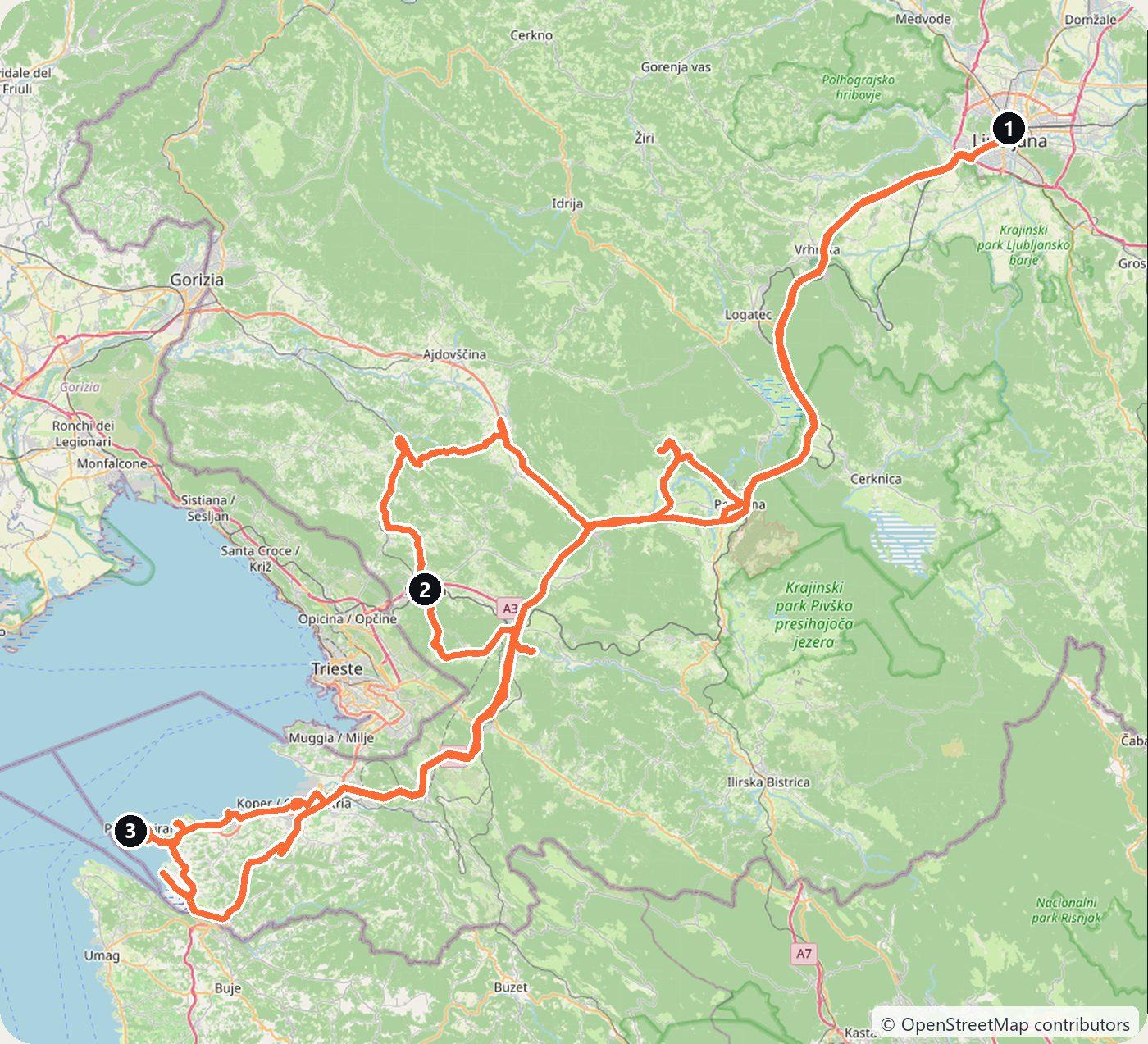
The Karst (Kras) is the limestone plateau between Ljubljana and the sea, the landscape that gave its name to karst geology everywhere. Rivers sink into it and carve caves under your wheels. This loop starts in Ljubljana, where you rent the car, and heads south-west, away from Bled and the Julian Alps. It takes in two of the best-known caves in Europe, Postojna and Škocjan, a castle built into a cliff, the stone village of Štanjel and the white horses of Lipica, then drops down to Slovenia’s short stretch of coast at Koper, Izola and Piran. It makes about 330 km in three days.
Most of the driving is on the A1 motorway, so you need the Slovenian e-vignette. The caves keep their own climate: 10 °C in Postojna and 12 °C in Škocjan all year, so bring a warm layer even in summer. In winter the coast is quiet, but the caves and castles stay open.
Day 1 — Ljubljana to Postojna, Predjama and Štanjel to Sežana (123 km)
Pick up the car in Ljubljana and take the A1 south-west to Postojna. Postojna Cave is part of a system of some 24 km of passages, and it had the world’s first underground cave railway, opened in 1872. Today a train takes you deep inside, and you walk the rest with a guide. The tour lasts about an hour and a half. Tickets are sold only on the official website, and an adult ticket is €34.90; there are combined tickets with Predjama Castle. Book a time slot in advance.
Drive about 9 km north-west to Predjama Castle, built into the middle of a 123 m cliff and standing there for some 800 years. Its best-known lord was the rebellious knight Erazem, who held out against an imperial siege for over a year; the story goes that he was killed on the toilet after a servant betrayed him. The castle is open all year, and the tour uses an app included in the ticket. The cave under the castle is open only in summer.
Cross the Karst plateau west to Štanjel, a stone village on the terraces of Turn Hill. Walk up to the castle, home of the Lojze Spacal Gallery, and the church of St Daniel with its lemon-shaped bell tower. Along the old east wall lies the Ferrari Garden, laid out by the architect Maks Fabiani, who was also the village’s mayor between the wars. From October to March the castle visitor centre lists daily opening hours from 9:00 to 11:00 and 12:00 to 16:00. Drive south to Sežana for the night.
Day 2 — Lipica and Škocjan Caves to Koper, Izola and Piran (73 km)
Start a few kilometres south at Lipica, the stud farm where the Lipizzaner horse comes from. The Habsburg Archduke Charles II founded it in 1580. Lipizzan breeding has been on UNESCO’s list of intangible heritage since 2022. The farm opens at 9:00, and guided tours of about an hour start at 10:00, 12:00, 14:00 and 16:00. A stud farm visit costs from €16; check on lipica.org whether there is a training session or a show on your day.
Drive east to Škocjan Caves, a UNESCO World Heritage Site since 1986. Here the river Reka has cut an underground canyon about 2,600 m long and up to 146 m high, and the path crosses it on the Cerkvenik Bridge, 47 m above the water. The tour starts at the reception centre, covers about 5 km with roughly 1,000 steps and takes 2.5–3 hours. Photography inside is not allowed. An adult ticket is €16 from November to March, €18 in April and October and €24 in July and August; the caves are closed on 25 December and 1 January. Buy online in advance.
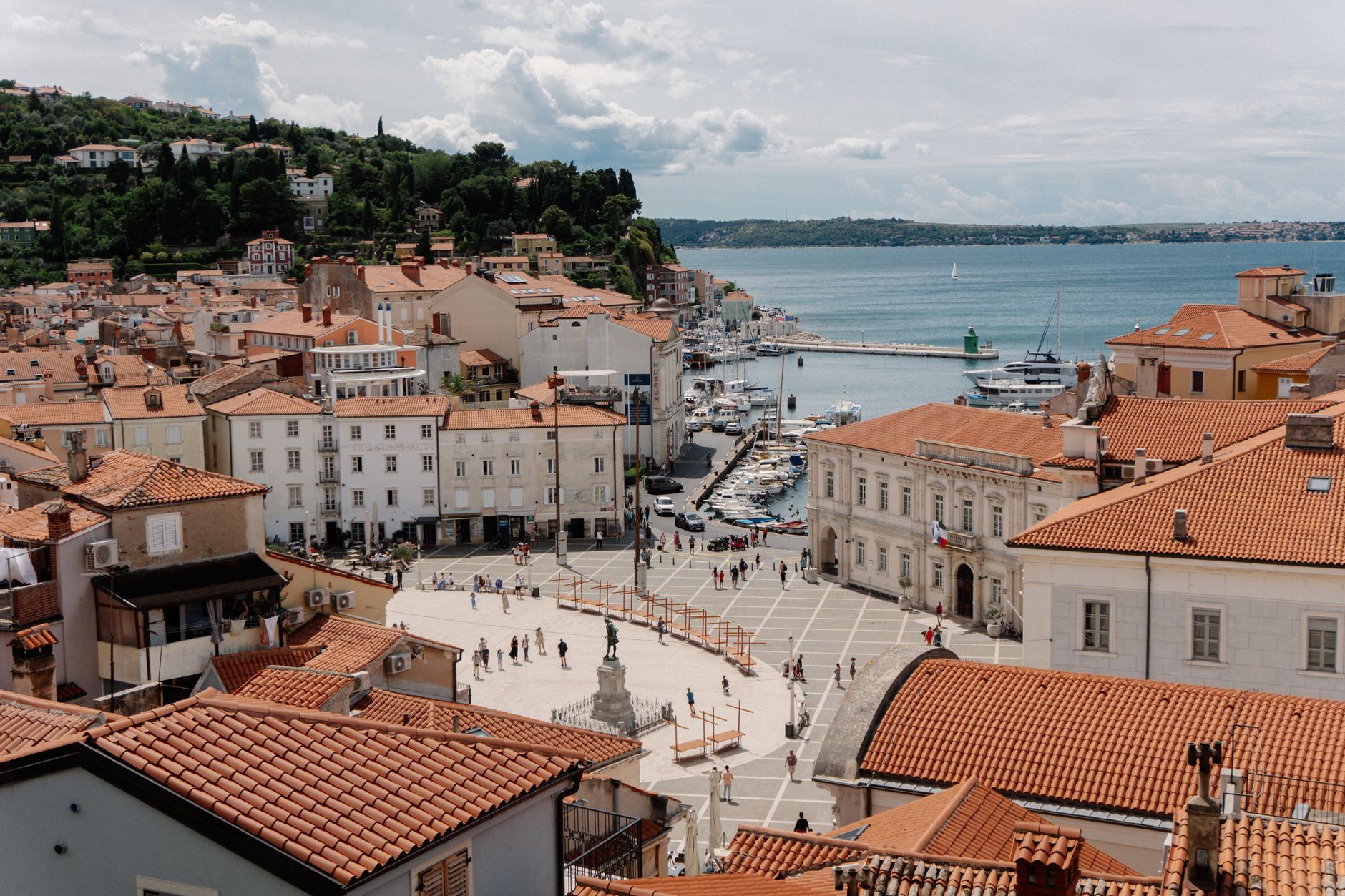
Take the A1 down to the coast at Koper. Its old town centres on Tito Square and the Venetian Gothic Praetorian Palace. Continue along the shore to Izola, a smaller old town on the water, then on to Piran. Piran’s old town is closed to visitors’ cars: you may drive in for up to 15 minutes to drop off people and bags, then leave the car at the Fornače garage (Garaža Fornače) at the edge of town. It is paid by the hour or by the day, and a minibus runs from it to Tartini Square. Sleep in Piran.
Day 3 — Piran, Strunjan and the Sečovlje salt pans to Ljubljana (134 km)
Spend the morning in Piran. Tartini Square is named after the violinist and composer Giuseppe Tartini, born here in 1692, and his statue stands in the middle. Climb to the church of St George above the town for the view across the roofs to the Adriatic.
Drive a few kilometres east to Strunjan. The Strunjan Landscape Park, set up in 2004, protects the Strunjan Cliff, a wall of flysch up to 80 m high above Moon Bay, which the park calls the highest cliff on the Adriatic.
Then drive south towards the Croatian border to the Sečovlje Salina Nature Park. Leave the car at the Lera entrance, on the right at the top of Seča hill, and walk out among the salt pans, where salt is still made the traditional way, on a cultivated crust called petola. Entry is paid. From 1 November to 31 March the park is open 8:00–17:00, but the Saltworks Museum at Fontanigge is closed. Then take the motorway back to Ljubljana, about 121 km.
Costs
Use the cost calculator to price fuel and nights for your dates. Slovenia has no motorway toll booths for cars; instead you need an e-vignette, bought online at evinjeta.dars.si and linked to your plate. For a car it costs €16 for a week or €32 for a month. If you rent in Slovenia, ask whether the car already has one. Since 1 January 2026 the coastal expressways H5 and H6 around Koper and Izola no longer need a vignette, but the A1 from Ljubljana does.
Budget for accommodation, fuel for about 330 km, car rental, parking at the Fornače garage in Piran and in Koper, and tickets for Postojna Cave, Predjama Castle, Škocjan Caves, Lipica and the Sečovlje salt pans. From 15 November to 15 March, and whenever there is snow or ice, cars must carry winter equipment: winter tyres (M+S) on all wheels or summer tyres with snow chains, with at least 3 mm of tread. On the coast, summer tyres with 3 mm of tread count as winter equipment, but the A1 over the Karst is not the coast.
This trip is also in the free Roadcut trip planner: change the number of days and where you sleep each night, pick your vehicle to see the fuel cost, check the weather on the road, and open each day in Google Maps, Apple Maps or Waze.
Where to stay on this route
Night by night, in the towns this itinerary sleeps in.
- Night 1Hotels in Sežana →
- Night 2Hotels in Piran →
The search opens with sample dates a month from today — change them to yours on Booking. Affiliate link — we may earn a commission at no extra cost to you.
The route on video
Get this itinerary by email
The days and the nights in your inbox, with a link back here when you are ready to book.
We use your address only to send this itinerary, unless you tick the box. Privacy
⚡ By electric car on this route
57 charging stations within 1.5 km of the road, 15 of them fast (DC). Most powerful: 250 kW.
Longest stretch without a fast charger tagged: 63 km, from km 48 of the route.
According to OpenStreetMap and operators’ websites. Fast = a DC plug or 50 kW and more; not every station has its power filled in, so there may be more. See them on the planner map → · EV charging →
🚦 Know before you go
Vignette · Tolls · Good to know
Vignette. Slovenia's motorways need a digital e-vignette (e-vinjeta), linked to your plate and bought online at evinjeta.dars.si: €16 for a week or €32 for a month for a car. This loop uses the A1 from Ljubljana past Postojna to the coast and back, so you need one. Since 1 January 2026 the coastal expressways H5 and H6 around Koper and Izola no longer need a vignette.
Tolls. No toll booths for cars: the e-vignette covers the motorways.
Good to know. Piran's old town is closed to visitors' cars: you may drive in for up to 15 minutes to drop off people and bags, then park in the Fornače garage and take the minibus to Tartini Square. Postojna Cave tickets are sold only online, and Škocjan Caves is closed on 25 December and 1 January; both caves stay at 10–12 °C all year. From 1 November to 31 March the Saltworks Museum at Sečovlje is closed. From 15 November to 15 March, and whenever there is snow or ice, cars need winter tyres (M+S, at least 3 mm tread) or summer tyres with snow chains.
Estimate your exact costs in the cost calculator. Prices are approximate — check official sites before you travel. Some links are affiliate links.
Plan this trip
Where to sleep
Hotels & B&Bs →Holiday homes & apartments →Campsites (bookable) →Campervan & overnight spots →Tours & tickets
Find things to do →Affiliate link — we may earn a commission at no extra cost to you.
Drive on from here
New road trips in your inbox
One email when we publish a new European route — the full guide, map and real costs. No spam, unsubscribe anytime.